IRS Digital Asset Rules: Crypto Tax-Loss Strategies
The new IRS digital asset rules necessitate understanding crypto tax-loss harvesting strategies to cut capital gains by up to 25%, offering crucial avenues for investors to minimize their tax burden and optimize their portfolio.
Navigating the evolving landscape of cryptocurrency taxation can feel daunting, especially with the new IRS digital asset rules: 3 crypto tax-loss harvesting strategies to cut capital gains by 25% now in effect. For many investors, understanding these changes is not just about compliance, but about unlocking significant opportunities to optimize their financial position.
Understanding the new IRS digital asset rules
The Internal Revenue Service (IRS) has significantly clarified its stance on digital assets, bringing much-needed, albeit complex, guidance to cryptocurrency investors. These new rules fundamentally redefine how digital assets are reported and taxed, moving beyond previous ambiguities to establish a more structured framework. It's crucial for every crypto holder to grasp these changes, as they directly impact potential tax liabilities and strategic financial planning.
Historically, the IRS treated cryptocurrencies as property, similar to stocks or real estate, for tax purposes. While this fundamental classification remains, the new regulations introduce more specific reporting requirements and definitions, aiming to close loopholes and ensure more comprehensive compliance. Investors must now be more diligent than ever in tracking their transactions, understanding cost bases, and accurately reporting gains and losses.
What constitutes a digital asset under IRS guidelines?
The IRS now broadly defines digital assets to include convertible virtual currency and non-fungible tokens (NFTs). This expansive definition means that a wide array of digital holdings, from Bitcoin and Ethereum to various altcoins and unique digital art, fall under the same tax scrutiny. This clarity, while helpful, also means that activities like staking rewards, airdrops, and even certain DeFi transactions are subject to specific tax treatments.
- Convertible Virtual Currency: Any digital representation of value that functions as a medium of exchange, a unit of account, or a store of value, and can be digitally traded or transferred.
- Non-Fungible Tokens (NFTs): Unique digital assets that are not interchangeable and are often used to represent ownership of digital or physical items.
- Stablecoins: Digital assets designed to maintain a stable value relative to a fiat currency or other asset, also fall under these rules.
These definitions are vital because they determine which of your digital activities are taxable events. Understanding this foundational aspect is the first step in effective tax planning and in leveraging strategies like crypto tax-loss harvesting.
In essence, the new IRS digital asset rules demand a higher level of record-keeping and a more sophisticated understanding of tax implications for every transaction. Ignoring these guidelines can lead to penalties, making proactive education and strategic implementation of tax-saving methods paramount for all crypto investors.

The strategic advantage of crypto tax-loss harvesting
Crypto tax-loss harvesting is a strategic maneuver that allows investors to sell digital assets at a loss to offset capital gains and potentially reduce ordinary income. This technique, long utilized in traditional markets, has gained significant traction in the volatile world of cryptocurrencies, offering a legitimate path to mitigate tax burdens. The inherent price fluctuations in the crypto market often create opportunities for losses, which, when strategically realized, can be turned into tax advantages.
The principle is straightforward: if you sell a cryptocurrency for less than you paid for it, you incur a capital loss. This loss can then be used to offset any capital gains you've realized from other crypto sales or even traditional investments. If your capital losses exceed your capital gains, you can typically deduct up to $3,000 of the remaining loss against your ordinary income each year, carrying forward any excess losses to future tax years.
Why is tax-loss harvesting particularly relevant for crypto?
Cryptocurrency markets are known for their extreme volatility, with significant price swings being a common occurrence. This volatility, while presenting risks, also creates frequent opportunities for investors to realize losses. Unlike traditional securities, where wash sale rules can complicate tax-loss harvesting, cryptocurrencies currently operate under different interpretations regarding these rules, although this is an area of ongoing discussion and potential future regulation.
- High Volatility: Frequent price movements create more opportunities to sell at a loss.
- Diverse Portfolios: Many crypto investors hold a wide range of assets, increasing the likelihood of some performing poorly while others gain.
- Potential for significant savings: A well-executed tax-loss harvesting strategy can significantly reduce your overall tax liability, potentially cutting capital gains by 25% or more depending on your individual tax bracket and the extent of your losses.
Effectively implementing crypto tax-loss harvesting requires careful planning and meticulous record-keeping. Investors must track their cost basis for each asset, the date of acquisition, and the date and price of sale. This diligent approach ensures that when opportunities arise, they can be accurately identified and leveraged for maximum tax benefit, aligning with the intent of the new IRS digital asset rules.
Strategy 1: Identifying and realizing sustained losses
The first crucial step in effective crypto tax-loss harvesting involves a systematic approach to identifying and realizing sustained losses within your portfolio. This isn't about impulsive selling during a market downturn, but rather a calculated decision based on a thorough analysis of your digital assets and their performance over time. Sustained losses refer to cryptocurrencies that have seen a significant and prolonged decline in value, with little immediate prospect of recovery, making them prime candidates for this strategy.
To begin, investors should regularly review their entire crypto portfolio, ideally on a quarterly or semi-annual basis, or whenever market conditions present clear opportunities. This review should involve comparing the current market value of each asset against its original purchase price (cost basis). Assets trading significantly below their cost basis, especially those that have been held for a longer duration, are strong contenders for realizing losses.
How to identify sustained losses effectively
Identifying sustained losses goes beyond merely seeing a red number. It involves a qualitative assessment of the asset's fundamentals, market sentiment, and its long-term viability. A token might be down 50% today, but if its underlying project is robust and the market is merely experiencing a temporary dip, selling it might not be the best long-term move. Conversely, a token down 20% with dwindling development and community support might be a better candidate for realizing a loss.
- Analyze Price History: Look for assets that have consistently traded below your cost basis for an extended period, indicating a more entrenched loss rather than a temporary fluctuation.
- Evaluate Project Fundamentals: Assess the health of the underlying project. Is development still active? Is there a strong community? Are there any major negative news or regulatory concerns?
- Consider Market Trends: Understand the broader market sentiment. Is the asset underperforming its peers, or is it part of a sector-wide downturn?
Once identified, the process involves selling these underperforming digital assets. The sale crystallizes the loss, making it available to offset capital gains. It's essential to document each sale meticulously, including the asset sold, the quantity, the sale price, the cost basis, and the date of the transaction. This detailed record-keeping is critical for accurate tax reporting and compliance with the new IRS digital asset rules.
Realizing sustained losses is a tactical move that requires both market insight and an understanding of your personal financial situation. By strategically offloading assets that are unlikely to recover their value in the short to medium term, you can transform a paper loss into a tangible tax benefit, thereby improving your overall financial standing.
Strategy 2: The 'sell and swap' approach for continuous exposure
The 'sell and swap' approach is a sophisticated crypto tax-loss harvesting strategy designed for investors who want to realize tax losses without completely exiting the digital asset market. This method allows you to maintain exposure to the crypto space while still benefiting from the tax advantages of selling an underperforming asset. It’s particularly useful in volatile markets where you might want to switch out of a declining asset into another with better prospects, all while generating a tax loss.
The core idea is to sell a cryptocurrency that has depreciated in value, thus realizing a capital loss. Immediately after selling, instead of repurchasing the same asset (which could be subject to wash sale rules if applied to crypto in the future, though current IRS guidance doesn't explicitly state it), you purchase a different, but similar, digital asset. This swap allows you to maintain your investment in the crypto ecosystem, potentially capturing future gains, while still using the realized loss to offset other capital gains.
Executing an effective 'sell and swap' strategy
Choosing the right replacement asset is paramount for the success of this strategy. The replacement should be sufficiently distinct from the asset you sold to avoid any potential interpretation issues regarding the wash sale rule, should the IRS apply it more broadly to crypto in the future. However, it should also align with your investment goals and risk tolerance, ensuring you don't compromise your portfolio's overall strategy.
- Diversify your replacements: Instead of buying a directly correlated asset, consider switching to a different blockchain technology, a different sector within crypto (e.g., DeFi to NFTs), or a stablecoin if you wish to temporarily de-risk.
- Research thoroughly: Before swapping, research the new asset's fundamentals, team, roadmap, and market potential to ensure it's a sound investment.
- Document everything: Maintain meticulous records of both the sale and the subsequent purchase, including transaction IDs, dates, prices, and quantities.
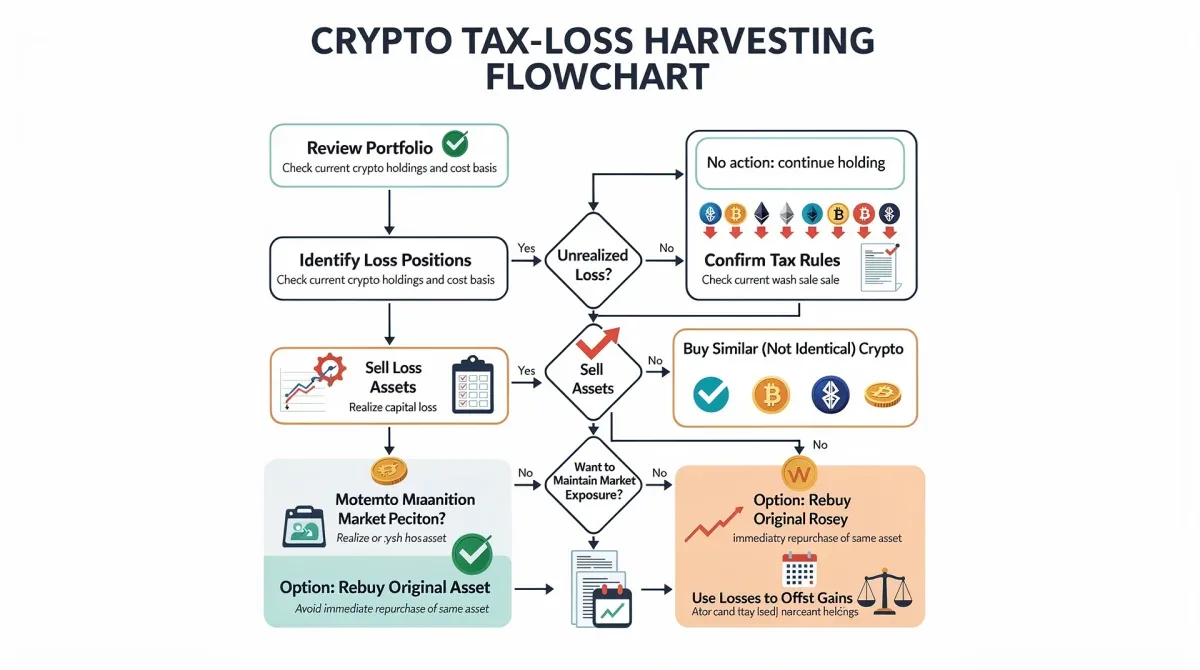
The 'sell and swap' approach offers a dynamic way to manage your crypto portfolio and tax obligations simultaneously. By strategically realizing losses and reallocating funds into other digital assets, you can enhance your tax efficiency without losing your footing in the burgeoning crypto market. This strategy aligns well with the proactive financial management encouraged by the new IRS digital asset rules, helping investors to cut capital gains by as much as 25% while staying invested.
Strategy 3: Leveraging long-term versus short-term losses
Understanding the distinction between long-term and short-term capital losses is fundamental to maximizing the benefits of crypto tax-loss harvesting under the new IRS digital asset rules. This third strategy focuses on strategically utilizing these different types of losses to optimize your tax position, potentially leading to more significant savings than simply realizing any loss.
A short-term capital loss occurs when you sell a digital asset that you've held for one year or less at a price lower than your cost basis. Conversely, a long-term capital loss results from selling an asset held for more than one year at a loss. The IRS treats these differently, and knowing how to apply them can significantly impact your tax liability.
Optimizing with short-term and long-term losses
The primary advantage of this distinction lies in how these losses offset gains. Short-term capital losses are first used to offset short-term capital gains, which are typically taxed at your ordinary income tax rate, often higher than long-term capital gains rates. Long-term capital losses are first used to offset long-term capital gains, which are subject to more favorable tax rates.
- Prioritize short-term losses: If you have both short-term and long-term gains, using short-term losses to offset short-term gains can be highly advantageous, as it reduces income taxed at your highest marginal rate.
- Offsetting excess losses: If your total capital losses exceed your total capital gains, you can deduct up to $3,000 of the remaining loss against your ordinary income. Any excess loss beyond this $3,000 limit can be carried forward indefinitely to future tax years.
- Strategic timing: Consider the holding period of your assets when planning sales. If an asset is nearing the one-year mark and is at a loss, deciding whether to sell it now for a short-term loss or hold it slightly longer for a long-term loss can be a calculated decision based on your overall tax picture.
By carefully managing the timing of your sales and understanding which losses offset which gains, you can significantly enhance your tax-loss harvesting strategy. This nuanced approach allows investors to cut capital gains by 25% or more, depending on their specific tax situation and the magnitude of their realized losses. It underscores the importance of a comprehensive understanding of tax law in the context of digital asset investing.
Calculating your potential tax savings
Accurately calculating your potential tax savings from crypto tax-loss harvesting is a critical step in understanding the true financial benefit of these strategies. It transforms abstract tax rules into tangible financial outcomes, allowing you to see how the new IRS digital asset rules can work in your favor. This calculation involves a clear understanding of your capital gains, capital losses, and your individual tax bracket.
The fundamental equation is straightforward: your realized capital losses directly reduce your capital gains. If your losses exceed your gains, you can then deduct up to $3,000 against your ordinary income. The actual savings come from multiplying these reduced taxable amounts by your applicable tax rates.
A practical approach to calculating savings
To illustrate, let's consider an investor with $10,000 in short-term crypto capital gains and $15,000 in short-term crypto capital losses. The first step is to offset the gains with the losses, resulting in a net capital loss of $5,000 ($15,000 losses - $10,000 gains). From this $5,000 net loss, the investor can deduct $3,000 against their ordinary income. If this investor is in the 24% tax bracket, this $3,000 deduction would save them $720 in taxes ($3,000 * 0.24). The remaining $2,000 in losses ($5,000 - $3,000) can be carried forward to future tax years.
- Identify all capital gains: Compile all realized gains from cryptocurrency sales and other investments.
- Identify all capital losses: Compile all realized losses from cryptocurrency sales.
- Determine your tax bracket: Your marginal tax rate will dictate the value of each dollar of deduction.
- Factor in long-term vs. short-term: Remember that short-term losses first offset short-term gains, and long-term losses offset long-term gains, before any net loss is applied against ordinary income.
The potential to cut capital gains by 25% or more is not an exaggeration. For an investor with substantial capital gains, strategically realizing losses can lead to significant reductions in their overall tax bill. This requires diligent record-keeping and potentially the use of crypto tax software to accurately track all transactions and calculate cost bases and gains/losses. By taking the time to calculate these savings, investors can fully appreciate the power of these crypto tax-loss harvesting strategies.
Avoiding common pitfalls in crypto tax reporting
While the new IRS digital asset rules offer opportunities for tax savings through strategies like crypto tax-loss harvesting, they also come with a heightened need for accurate reporting to avoid common pitfalls. Missteps in reporting can lead to audits, penalties, and unnecessary headaches. Investors must be vigilant and proactive in their compliance efforts, recognizing that the IRS is increasingly sophisticated in tracking digital asset transactions.
One of the most frequent errors is inadequate record-keeping. The decentralized nature of cryptocurrency means that transactions often occur across multiple exchanges, wallets, and platforms, making it challenging to maintain a comprehensive ledger. Without precise records of every buy, sell, trade, and transfer, accurately calculating cost basis, gains, and losses becomes nearly impossible, jeopardizing any tax-loss harvesting strategy.
Key areas for careful attention
Beyond basic transaction tracking, several other areas demand meticulous attention to ensure full compliance and avoid pitfalls. These often involve nuances of digital asset activity that might not have direct parallels in traditional finance.
- Wash Sale Rule Misconceptions: While the IRS has not explicitly applied the wash sale rule (which prohibits selling an asset at a loss and repurchasing a substantially identical one within 30 days) to cryptocurrencies, this remains an area of ambiguity. Prudent investors might still consider a waiting period or swapping for a distinctly different asset to mitigate future risks.
- Incorrect Cost Basis Calculation: Using the wrong cost basis method (e.g., FIFO, LIFO, specific identification) can lead to significant inaccuracies in reported gains and losses. It's crucial to understand which method you are using and apply it consistently.
- Failure to Report All Taxable Events: Many crypto activities beyond simple buying and selling are taxable events. This includes receiving staking rewards, airdrops, mining income, and even using crypto for purchases. Each of these must be accurately valued and reported as income or capital events.
To navigate these complexities, many investors turn to specialized crypto tax software. These tools can integrate with various exchanges and wallets, automate transaction tracking, and help generate the necessary tax forms (like Form 8949). By understanding and actively avoiding these common pitfalls, investors can confidently leverage crypto tax-loss harvesting strategies and maintain compliance with the new IRS digital asset rules, ultimately cutting capital gains by 25% or more.
The future of crypto tax reporting and compliance
The landscape of crypto tax reporting and compliance is far from static; it's an evolving domain, constantly adapting to technological advancements and regulatory developments. The new IRS digital asset rules are a significant step, but they are likely just a prelude to further refinements and potentially more stringent enforcement. Investors must remain agile and informed, anticipating future changes to maintain optimal tax efficiency and compliance.
One of the most anticipated developments is the potential for increased data sharing between crypto exchanges and tax authorities. As exchanges become more regulated and integrated into traditional financial systems, the ability of the IRS to track transactions will only improve. This means that hiding crypto activity will become increasingly difficult, underscoring the importance of transparent and accurate reporting from the outset.
Anticipating future regulatory changes
Several key areas are ripe for further regulatory clarification or expansion, which could impact crypto tax-loss harvesting strategies.
- Wash Sale Rule for Crypto: The application of the wash sale rule to digital assets remains a hot topic. Should the IRS explicitly extend this rule to cryptocurrencies, it would significantly alter the 'sell and swap' strategy, requiring investors to wait 30 days before repurchasing a substantially identical asset.
- DeFi and NFT Taxation: While current rules offer some guidance, the complexities of decentralized finance (DeFi) protocols and the unique characteristics of NFTs mean that more specific regulations are likely to emerge, particularly concerning lending, borrowing, and fractional ownership.
- International Cooperation: As crypto becomes a global phenomenon, international cooperation on tax enforcement will likely increase, making it harder for investors to use offshore accounts to avoid tax obligations.
Staying informed about legislative proposals, IRS guidance, and industry best practices is crucial. Subscribing to reputable financial news sources, consulting with tax professionals specializing in digital assets, and utilizing up-to-date crypto tax software are all essential components of a forward-looking compliance strategy. By proactively adapting to these changes, investors can continue to leverage strategies like crypto tax-loss harvesting to cut capital gains by 25% or more, ensuring their financial health in the ever-evolving world of crypto investing.
| Key Strategy | Brief Description |
|---|---|
| Identify Sustained Losses | Regularly review portfolio to sell digital assets with prolonged value decline to realize capital losses. |
| Sell and Swap Approach | Sell an underperforming crypto for a loss, then immediately buy a different, similar asset to maintain market exposure. |
| Leverage Long vs. Short-Term Losses | Strategically use short-term losses to offset high-taxed short-term gains, and long-term losses for lower-taxed long-term gains. |
| Accurate Record-Keeping | Maintain meticulous records of all crypto transactions to ensure correct cost basis and compliance with IRS rules. |
Frequently asked questions about crypto tax-loss harvesting
What are the new IRS digital asset rules? ▼The new IRS digital asset rules clarify how cryptocurrencies and NFTs are taxed, treating them as property. They mandate detailed reporting of all digital asset transactions, including buying, selling, trading, and receiving income from activities like staking or airdrops. This aims to enhance compliance and provide clearer guidance for investors.
How does crypto tax-loss harvesting work? ▼Crypto tax-loss harvesting involves selling digital assets at a loss to offset capital gains. These realized losses can reduce your overall capital gains tax liability. If your losses exceed gains, you can deduct up to $3,000 against ordinary income, carrying forward any remaining losses to future tax years.
Is the wash sale rule applicable to cryptocurrencies? ▼Currently, the IRS has not explicitly applied the wash sale rule, which prohibits repurchasing a substantially identical asset within 30 days of selling it for a loss, to cryptocurrencies. However, this is an area of ongoing discussion. Many advisors suggest caution by waiting or buying a different asset to avoid potential future issues.
What is the difference between short-term and long-term crypto losses? ▼Short-term crypto losses result from selling an asset held for one year or less, while long-term losses are from assets held for over a year. Short-term losses first offset short-term gains (taxed at ordinary income rates), and long-term losses offset long-term gains (taxed at preferential rates), impacting overall tax efficiency.
How can I ensure accurate crypto tax reporting? ▼To ensure accurate reporting, maintain meticulous records of all crypto transactions, including dates, prices, and quantities. Utilize specialized crypto tax software to automate tracking and calculate cost basis. Consulting a tax professional experienced in digital assets can also provide invaluable guidance and ensure compliance with IRS regulations.
Conclusion
The evolving landscape of digital asset taxation, particularly with the new IRS digital asset rules, underscores the critical importance of strategic financial planning for crypto investors. By understanding and proactively implementing crypto tax-loss harvesting strategies, investors can effectively cut capital gains by 25% or more, significantly mitigating their tax burden. From identifying sustained losses and executing 'sell and swap' maneuvers to strategically leveraging long-term versus short-term losses, each approach offers a distinct pathway to optimizing your financial position. Diligent record-keeping and staying informed about regulatory changes are not merely compliance necessities, but powerful tools that transform potential liabilities into tangible savings, ensuring a robust and tax-efficient crypto investment journey.
