
Formal Verification in Solidity: 5 Protocol Security Flaws
Formal verification in Solidity is a crucial process that mathematically proves the correctness of smart contracts, identifying critical security flaws before mainnet deployment and significantly enhancing the robustness and trustworthiness of blockchain protocols.
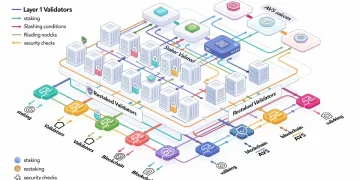
Restaking Architecture: Eliminating Validator Slashing Risks
Restaking architecture offers a paradigm shift in blockchain security, enabling validators to reuse staked assets to secure multiple Actively Validated Services (AVS) while introducing new mechanisms to mitigate slashing risks, thereby enhancing overall network integrity and efficiency.

Modular Blockchain Design: Latency Under 250ms
Modular blockchain design fundamentally redefines network architecture by separating core functions, particularly data availability, leading to a dramatic reduction in transaction latency, often below 250 milliseconds, and greatly improving overall blockchain performance and scalability.
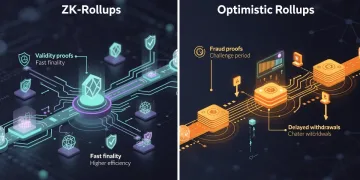
ZK-Rollups vs. Optimistic Rollups: Cut Smart Contract Costs by 88%
ZK-Rollups and Optimistic Rollups are pivotal Layer-2 scaling solutions that bundle transactions off-chain to significantly reduce smart contract execution costs, with some implementations achieving up to an 88% reduction, thereby enhancing blockchain efficiency and accessibility.

Blockchain Interoperability: Cross-Chain Solutions for US Enterprises
Blockchain interoperability enhances cross-chain solutions for US enterprises by enabling seamless asset and data transfer between different blockchain networks, fostering innovation and efficiency. Blockchain Interoperability: A Deep Dive into Cross-Chain Solutions for US Enterprises in the Next 6 Months stands as a crucial element for future growth, paving the way for seamless collaboration and the […]

Smart Contract Security Audits: US Best Practices to Prevent Exploits
Smart contract security audits are crucial for identifying vulnerabilities and preventing exploits on US-based blockchain platforms. These audits involve rigorous testing and analysis to ensure the code’s security, reliability, and adherence to best practices, safeguarding valuable assets and user trust. Smart contracts are revolutionizing industries, but their security is paramount, especially on US-based blockchain platforms. […]

Proof-of-Stake vs. Proof-of-Work: Energy Consumption in US
Proof-of-Stake (PoS) and Proof-of-Work (PoW) are consensus mechanisms used in blockchain technology, with PoS emerging as a more energy-efficient alternative to PoW, especially in the United States, due to its significantly lower electricity consumption. The world of blockchain technology relies on consensus mechanisms to validate transactions and secure the network. Among these, Proof-of-Stake vs. Proof-of-Work: […]

Blockchain Scalability in 2025: Layer-2 Tech Comparison for High Throughput
Blockchain scalability solutions, particularly layer-2 technologies like rollups, sidechains, and state channels, are crucial for achieving high-throughput applications by 2025, addressing the limitations of layer-1 blockchains and enabling broader adoption. The blockchain’s promise of decentralization and security often clashes with its scalability limitations. Exploring blockchain scalability solutions: comparing layer-2 technologies for high-throughput applications in 2025, […]

Blockchain Supply Chain Management: US Tracking with 99% Accuracy
Blockchain supply chain management in the US offers near-perfect accuracy in tracking products from origin to consumer by employing a distributed, immutable ledger system that enhances transparency and efficiency. Blockchain supply chain management: Tracking products from origin to consumer in the US with 99% accuracy is revolutionizing how businesses operate. This innovative approach ensures unparalleled […]

Blockchain Governance Models: Decentralized Impact on US Projects
Blockchain Governance Models: How Decentralized Decision-Making Impacts US Blockchain Projects examines various governance structures, highlighting their influence on the efficiency, security, and regulatory compliance of blockchain initiatives within the United States. The rise of blockchain technology has brought forth innovative solutions across various sectors, but the backbone of any successful blockchain project lies in its […]