Modular Blockchain Design: Latency Under 250ms
Modular blockchain design fundamentally redefines network architecture by separating core functions, particularly data availability, leading to a dramatic reduction in transaction latency, often below 250 milliseconds, and greatly improving overall blockchain performance and scalability.
The evolution of blockchain technology has reached a critical juncture, demanding solutions that address inherent limitations in scalability and transaction speed. One of the most promising advancements in this realm is modular blockchain design, a paradigm shift that fundamentally reconfigures how decentralized networks operate. By decoupling key functions, particularly data availability, modular architectures are achieving unprecedented transaction latency, often falling comfortably under 250 milliseconds, transforming the landscape for high-performance decentralized applications.
Understanding the Monolithic Blockchain Bottleneck
Traditional blockchains, often referred to as monolithic, are designed to handle all core functions—execution, settlement, consensus, and data availability—within a single, integrated layer. While this design offers simplicity and robust security in its early iterations, it inherently introduces significant bottlenecks as network demand grows. Every node must process every transaction, store all data, and participate in every consensus round, leading to a direct correlation between network activity and performance degradation.
This integrated approach, while foundational, restricts the throughput and responsiveness necessary for widespread adoption. As more users and applications attempt to interact with the blockchain, the single-layer design struggles to keep up, resulting in slower transaction confirmations and higher fees. The cumulative load on each node escalates, making it increasingly difficult for ordinary participants to run a full node, thus potentially centralizing the network over time.
Challenges of Monolithic Architectures
- Limited Throughput: A single chain processing all operations simultaneously cannot handle a high volume of transactions per second without becoming congested.
- High Latency: Transaction confirmation times are extended due to the sequential nature of block processing and the need for global consensus on every aspect.
- Lack of Specialization: Nodes are generalists, performing all tasks rather than specializing in specific functions, which is inefficient.
- Resource Intensive: Running a full node requires substantial computational power, storage, and bandwidth, leading to higher operational costs.
These challenges collectively underscore the limitations of the monolithic model in an increasingly demanding digital landscape. The vision of a truly global, scalable, and decentralized internet requires a more agile and efficient underlying infrastructure. The inability to efficiently handle transaction volume and speed has been a primary barrier to mainstream acceptance and the development of complex decentralized applications that require near-instantaneous feedback.
In essence, the monolithic design, while pioneering, has reached its practical limits for high-performance use cases. The need for a more flexible and specialized architecture has become undeniable, paving the way for the emergence of modular blockchain solutions that address these fundamental constraints head-on.
The Core Principle of Modular Blockchain Design
Modular blockchain design represents a fundamental paradigm shift, moving away from the 'one-size-fits-all' monolithic structure towards a specialized, layered approach. The core principle lies in decoupling the various functions traditionally handled by a single blockchain into distinct, interoperable layers. These functions typically include execution, settlement, consensus, and crucially, data availability. By separating these concerns, each layer can be optimized for its specific task, leading to significant improvements in efficiency, scalability, and performance.
This architectural separation allows for parallel processing and specialized resource allocation. For instance, a layer focused solely on transaction execution can be optimized for speed and computational throughput, while another layer dedicated to data availability can ensure the robust and efficient storage and retrieval of transaction data. This specialization mitigates the bottlenecks inherent in monolithic designs, where a single layer must perform all functions simultaneously.
Key Components of a Modular Blockchain
- Execution Layer: Where transactions are processed and smart contracts are executed. This layer can be highly optimized for computational efficiency.
- Settlement Layer: Responsible for finalizing transactions and providing dispute resolution mechanisms. It acts as a bridge between various execution layers.
- Consensus Layer: Ensures agreement among network participants on the order and validity of transactions. It maintains the security and integrity of the chain.
- Data Availability Layer: Guarantees that all transaction data is published and accessible to all network participants, a critical component for security and verifiability.
By abstracting these functions into separate modules, developers gain greater flexibility in designing and optimizing specific aspects of the blockchain. This modularity not only enhances performance but also fosters innovation by allowing different teams to focus on improving individual components without affecting the entire system. The ability to upgrade or modify one layer independently of others significantly reduces development cycles and enhances adaptability.
The modular approach fosters a more resilient and versatile ecosystem. Instead of a single point of failure or bottleneck, the system can distribute workload and leverage specialized optimizations across its layers. This foundational shift is what enables the dramatic improvements in transaction latency and overall throughput, making blockchains viable for a wider array of applications that demand high performance.
Decoupling Data Availability: The Game Changer
The decoupling of data availability is arguably the most impactful innovation within modular blockchain design, directly addressing one of the primary hurdles to scalability and speed. In a monolithic blockchain, every full node must download and store all transaction data to verify the chain's state. This process is resource-intensive and becomes a significant bottleneck as the volume of transactions increases, directly contributing to higher latency.
By contrast, in a modular architecture, the data availability layer (DA layer) is responsible solely for ensuring that transaction data is published and accessible to all participants. This means that execution layers, such as rollups, can process transactions off-chain, then submit compressed transaction data or proofs to the DA layer. The DA layer then guarantees that this data is available for anyone to reconstruct the state or verify transactions, without needing every node to re-execute every single transaction.
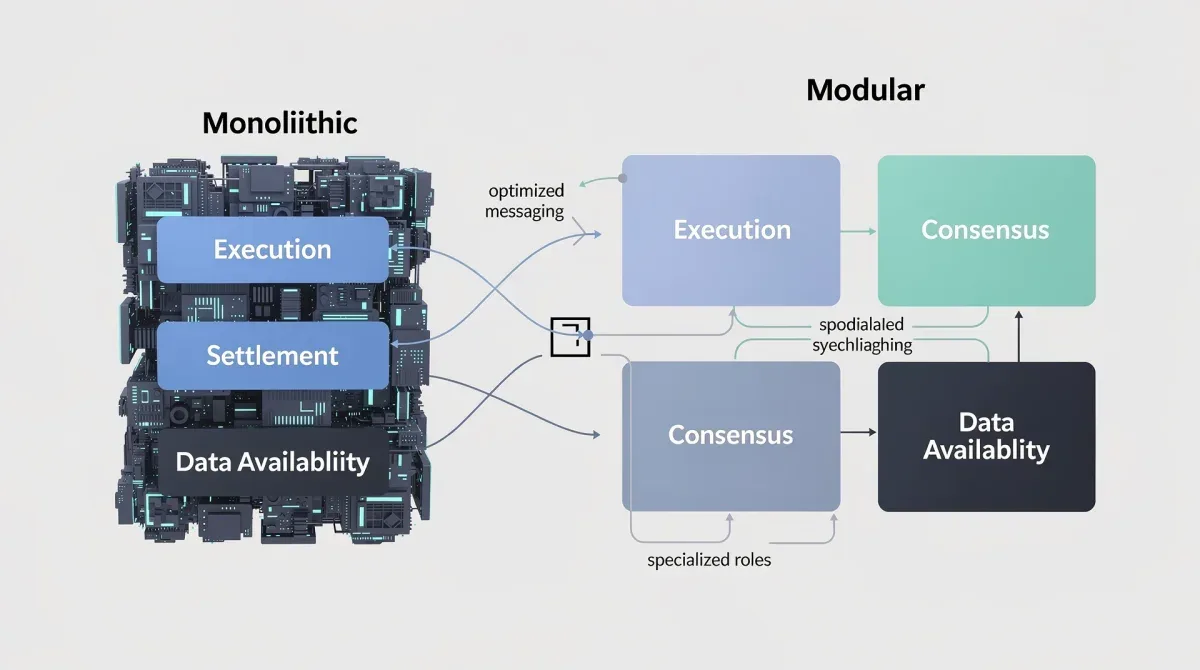
This separation allows for a significant reduction in the data that each node in the execution layer needs to process and store. Instead of full transaction data, nodes might only need proofs or summaries, drastically lightening their computational and storage load. This efficiency is paramount for achieving high throughput and low latency, as the network can process more transactions faster without being bogged down by redundant data propagation.
How Decoupling Enhances Efficiency
- Reduced Bandwidth Requirements: Execution layers only need to submit concise proofs or aggregated data to the DA layer, rather than raw transaction data, lowering network traffic.
- Parallel Processing: Different execution layers can operate in parallel, all leveraging the same underlying DA layer, significantly increasing overall network throughput.
- Optimized Storage: The DA layer can be specialized for efficient data storage and retrieval, potentially using techniques like data sharding to further enhance performance.
- Improved Verifiability: While data is not processed by every node, its availability ensures that anyone can verify the integrity of the chain, maintaining decentralization and security.
The implications of this decoupling are profound. It transforms the blockchain from a singular, sequential processing unit into a highly parallel and specialized ecosystem. This architectural flexibility is what allows modular blockchains to push the boundaries of performance, making transaction latency under 250 milliseconds not just a theoretical possibility but a practical reality. The ability to scale data availability independently means that the entire system can grow more efficiently and sustainably, meeting the demands of a global user base.
Achieving Sub-250 Millisecond Transaction Latency
The promise of modular blockchain design culminates in its ability to dramatically reduce transaction latency, pushing it below the critical 250-millisecond threshold. This level of responsiveness is comparable to traditional financial systems and is essential for real-time applications, gaming, and high-frequency trading in decentralized environments. The key to achieving such speeds lies in the combined efficiencies gained from specialized layers, particularly the optimized data availability layer and highly efficient execution environments.
By offloading the heavy computational and storage burden of data availability, execution layers can process transactions with remarkable speed. Rollups, for instance, bundle hundreds or thousands of transactions off-chain, generate a cryptographic proof of their validity, and then submit this proof and a minimal amount of data to the base layer (which includes the DA layer). This drastically reduces the on-chain footprint and the time required for transactions to be confirmed and finalized.

Techniques for Speed Optimization
- Optimistic Rollups: These execute transactions off-chain and assume they are valid, only requiring on-chain verification if a dispute arises. This significantly speeds up confirmation times.
- Zero-Knowledge Rollups (ZK-Rollups): These generate cryptographic proofs (ZK-proofs) of off-chain transaction validity, which are then submitted to the main chain. These proofs are instantly verifiable, offering strong security and fast finality.
- Data Availability Sampling (DAS): Rather than requiring every node to download all data, nodes can sample small portions of data to verify its availability, reducing bandwidth and increasing network efficiency.
- Parallel Execution Environments: Multiple execution layers can operate concurrently, each processing transactions independently, thereby increasing the overall transaction throughput of the system.
The synergy of these technologies allows modular blockchains to handle a much larger volume of transactions simultaneously without sacrificing speed or security. The reduction in latency is not merely incremental; it is a transformative leap that opens up new possibilities for decentralized applications. Developers can now build applications that require near-instantaneous feedback, such as interactive games, decentralized exchanges with real-time order books, and high-throughput payment systems, all while maintaining the core principles of decentralization and security.
This ability to achieve sub-250 millisecond latency is a testament to the power of specialized, modular design. It redefines what is possible within the blockchain space, moving it closer to mainstream adoption by addressing one of its most persistent performance challenges. The future of decentralized technology hinges on such advancements, making modular architectures a cornerstone of the next generation of Web3 innovation.
Impact on Scalability and Decentralization
The advancements in modular blockchain design, particularly the decoupling of data availability, have profound implications for both scalability and decentralization. Historically, there has been a perceived trade-off between these two critical aspects of blockchain technology, often referred to as the 'blockchain trilemma.' Modular architectures aim to overcome this by enabling significant improvements in scalability without compromising decentralization.
By specializing layers, modular blockchains can process a far greater number of transactions per second (TPS) than their monolithic counterparts. Execution layers can scale horizontally, adding more rollups or shards, each processing transactions independently and efficiently. The data availability layer can also be optimized for high throughput, ensuring that all this additional transaction data remains accessible and verifiable. This enhanced scalability is crucial for supporting a global user base and the complex applications of Web3.

Preserving Decentralization through Modularity
- Reduced Node Requirements: Because full nodes on execution layers don't need to process or store all data, the hardware requirements for running a node are significantly reduced. This makes it easier for more individuals to participate, increasing the number of active validators and decentralizing the network.
- Data Availability Sampling (DAS): Techniques like DAS allow light clients and ordinary users to verify data availability by sampling small portions of data, rather than downloading the entire dataset. This empowers more participants to independently verify the chain's integrity, fostering a more decentralized ecosystem.
- Layered Security: The security of modular blockchains often relies on a robust base layer (e.g., Ethereum), which provides strong consensus and settlement guarantees. Execution layers inherit this security while operating at higher speeds, ensuring that decentralization is maintained at the foundational level.
- Open Innovation: The modular structure encourages a diverse ecosystem of execution layers, each potentially developed by different teams. This prevents a single entity from dominating the entire blockchain stack, promoting a more decentralized and resilient development landscape.
The ability to scale efficiently while simultaneously lowering the barrier to entry for node operators is a game-changer. It means that modular blockchains can support a massive influx of users and transactions without resorting to solutions that compromise the core tenets of decentralization. This harmonious balance is essential for the long-term health and widespread adoption of blockchain technology, ensuring that power remains distributed among participants rather than concentrated in a few hands.
Ultimately, modular blockchain design offers a pathway to a future where decentralized applications can achieve global scale and performance, all while upholding the fundamental values of censorship resistance and user sovereignty. This approach is not just about speed; it's about building a more robust, accessible, and truly decentralized digital infrastructure.
Challenges and Future Outlook
While modular blockchain design offers a compelling vision for a scalable and high-performance decentralized future, it is not without its challenges. The complexity of coordinating multiple specialized layers, ensuring seamless interoperability, and maintaining robust security across the entire stack requires significant engineering effort and ongoing innovation. Integrating various execution, settlement, consensus, and data availability layers into a cohesive and secure ecosystem presents a multifaceted technical puzzle.
One primary challenge lies in the security model. While individual layers can be highly secure, the interactions between them introduce new attack vectors. Ensuring that data is correctly passed, proofs are valid, and state transitions are accurate across different modules requires rigorous design and testing. Additionally, the user experience can become more complex, as users might need to interact with different interfaces or understand the nuances of various layers, potentially hindering adoption for less technical individuals.
Overcoming Obstacles and Future Directions
- Standardization Efforts: Developing common standards and protocols for inter-layer communication and data exchange will simplify integration and enhance security.
- Improved Tooling and Developer Experience: Creating more intuitive development kits, libraries, and frameworks will lower the barrier for developers to build on modular chains.
- Enhanced Bridging Solutions: More robust and secure bridging mechanisms are needed to facilitate asset transfer and communication between different modular components and other blockchain networks.
- Economic Security Models: Designing incentive mechanisms that align the interests of all participants across different layers, ensuring the overall economic security of the modular system.
- Research in Advanced Cryptography: Continued advancements in zero-knowledge proofs and other cryptographic techniques will further enhance the efficiency and privacy of modular transactions.
The future outlook for modular blockchain design is incredibly promising. As these challenges are addressed, we can expect to see an accelerating pace of innovation and adoption. The ability to achieve sub-250 millisecond transaction latency, combined with enhanced scalability and preserved decentralization, positions modular blockchains as the foundational infrastructure for the next generation of the internet. This will enable a vast array of new applications, from truly real-time decentralized finance to highly interactive metaverse experiences and beyond.
The journey towards a fully realized modular blockchain ecosystem is ongoing, but the progress made so far indicates a clear path toward a more efficient, scalable, and user-friendly decentralized future. The continuous evolution of these architectures will be critical in shaping the digital economy of tomorrow.
| Key Aspect | Brief Description |
|---|---|
| Modular Design | Separates blockchain functions into specialized layers for efficiency. |
| Data Availability Decoupling | Ensures transaction data is accessible without every node processing it directly. |
| Reduced Latency | Enables transaction finality under 250 milliseconds, boosting real-time application support. |
| Enhanced Scalability | Allows parallel processing and higher transaction throughput, supporting more users. |
Frequently Asked Questions About Modular Blockchains
What is modular blockchain design?▼Modular blockchain design is an architectural approach that separates the core functions of a blockchain (execution, settlement, consensus, data availability) into distinct, specialized layers. This allows each layer to be optimized independently, leading to greater efficiency, scalability, and flexibility compared to traditional monolithic blockchains.
How does data availability decoupling reduce latency?▼By decoupling data availability, execution layers can process transactions off-chain and only submit condensed proofs or data summaries to the data availability layer. This significantly reduces the amount of data that needs to be processed and stored by every node, accelerating transaction confirmation times and reducing overall network congestion and latency.
What are the benefits of sub-250ms transaction latency?▼Sub-250ms transaction latency enables real-time decentralized applications, such as high-frequency trading, interactive gaming, and instant payments. This speed makes blockchain technology more competitive with traditional systems, fostering broader adoption and enabling new use cases that require immediate feedback and high throughput.
Does modular design compromise decentralization?▼No, modular design aims to enhance or preserve decentralization. By reducing the hardware requirements for running nodes and enabling data availability sampling, it makes it easier for more participants to join and verify the network. This distributed participation strengthens decentralization, preventing consolidation of power among a few large entities.
What role do rollups play in modular blockchains?▼Rollups are crucial execution layers in modular blockchains. They aggregate and process numerous transactions off-chain, then submit a single, compressed proof or data batch to the base chain. This significantly boosts transaction throughput and reduces costs, leveraging the data availability layer to ensure the integrity and accessibility of the off-chain processed data.
Conclusion
The advent of modular blockchain design marks a pivotal moment in the evolution of decentralized technologies. By strategically decoupling core functionalities, particularly data availability, this innovative architecture addresses the long-standing challenges of scalability and high transaction latency that have hindered mainstream blockchain adoption. The ability to achieve transaction finality under 250 milliseconds is not merely an incremental improvement; it is a transformative leap that unlocks a new era of high-performance decentralized applications and services. As the ecosystem matures and technical complexities are refined, modular blockchains are poised to become the bedrock of a more efficient, scalable, and truly decentralized digital future, driving widespread innovation across various industries.
