Restaking Architecture: Eliminating Validator Slashing Risks
Restaking architecture offers a paradigm shift in blockchain security, enabling validators to reuse staked assets to secure multiple Actively Validated Services (AVS) while introducing new mechanisms to mitigate slashing risks, thereby enhancing overall network integrity and efficiency.
The burgeoning landscape of decentralized finance introduces innovative mechanisms to enhance blockchain security and utility. Among these, restaking slashing risks in actively validated services (AVS) presents both a groundbreaking opportunity and a complex challenge for validators. Understanding the architecture and implementing robust technical benchmarks is paramount to safeguarding network integrity.
Understanding restaking architecture and its implications
Restaking is an innovative concept within the blockchain ecosystem that allows staked Ether (ETH) in Ethereum's proof-of-stake consensus layer to be re-used to secure other decentralized applications or actively validated services (AVS). This mechanism aims to extend Ethereum's security guarantees to a broader range of protocols, fostering a more interconnected and robust decentralized infrastructure.
The core idea behind restaking is capital efficiency. Instead of requiring separate stakes for each service, validators can leverage their existing ETH stake to participate in multiple AVS. While this offers significant benefits, it also introduces additional layers of complexity and potential risks, particularly concerning slashing conditions. A comprehensive understanding of the underlying architecture is essential for both validators and users to navigate this evolving space effectively.
The dual benefits and inherent risks of restaking
Restaking promises enhanced security for new protocols and increased yield opportunities for validators. By utilizing a shared security model, nascent AVS can bootstrap their security without needing to establish their own validator sets from scratch. This shared security model creates a powerful network effect.
- Enhanced security for AVS: New protocols benefit from the economic security of Ethereum's vast validator set.
- Increased validator yield: Validators can earn additional rewards by securing multiple services with the same staked capital.
- Capital efficiency: Reduces the overall capital required to secure the decentralized ecosystem.

However, this increased utility comes with inherent risks. Validators are now exposed to slashing conditions from multiple protocols, not just Ethereum's consensus layer. A single malicious or erroneous action could lead to penalties from several AVS, amplifying potential losses. This necessitates a meticulous approach to protocol design and operational practices.
The implications of restaking extend beyond individual validators; they affect the entire ecosystem's stability. A cascading failure due to widespread slashing events could undermine trust and lead to significant economic disruption. Therefore, the architectural design must prioritize resilience and clear, enforceable rules to prevent such scenarios, ensuring the long-term viability of restaking.
Benchmark 1: Robust slashing condition design
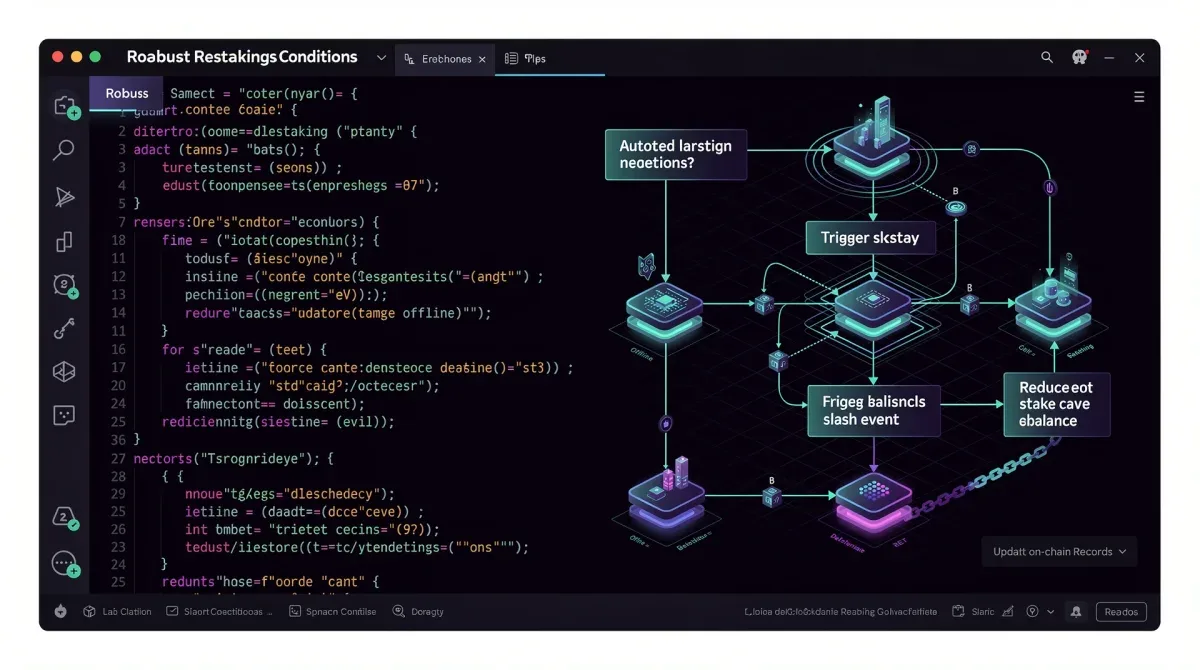
The foundation of eliminating validator slashing risks in restaking architecture lies in the meticulous design of slashing conditions. These conditions must be clear, unambiguous, and technically enforceable across all integrated Actively Validated Services (AVS). A poorly defined slashing mechanism can lead to unfair penalties, deterring participation, or, conversely, fail to punish malicious behavior effectively, compromising security.
Effective slashing condition design involves a multi-faceted approach, combining cryptographic proofs, on-chain monitoring, and transparent dispute resolution mechanisms. The goal is to create a system where validator misbehavior is undeniably detected and appropriately penalized, without introducing undue complexity or false positives.
Defining clear and objective slashing triggers
For each AVS, specific actions that warrant slashing must be explicitly defined. These triggers should be objective and verifiable, ideally through automated processes. Ambiguity in defining slashing triggers can lead to subjective interpretations and disputes, undermining the system's fairness and predictability.
- Double signing: A validator signs two conflicting blocks or attestations for the same slot or epoch.
- Inactivity: A validator fails to perform their duties (e.g., proposing blocks, making attestations) for an extended period.
- Malicious oracle reporting: Providing incorrect or manipulated data as an oracle for an AVS.
- Incorrect state transitions: Validating an invalid state transition within an AVS.
Beyond these, AVS-specific slashing conditions might emerge, reflecting their unique operational requirements. It is crucial that these are clearly documented and communicated to validators before they opt into securing the service. Transparency in these rules builds trust and allows validators to assess their risk exposure accurately.
The design should also consider the severity of penalties. Minor infractions might warrant a small penalty, while egregious malicious acts should incur significant slashing. This tiered approach ensures proportionality and acts as a strong deterrent against harmful behavior. Furthermore, mechanisms for automatic detection and execution of slashing events are vital to ensure timely and impartial enforcement.
Benchmark 2: Multi-layer security and isolation
A robust restaking architecture demands a multi-layer security approach to protect against vulnerabilities and ensure the isolation of risks between different Actively Validated Services (AVS). While restaking aims to share security, it should not lead to a single point of failure where a compromise in one AVS jeopardizes the entire staked capital across all services. Proper isolation mechanisms are critical.
This benchmark focuses on designing the protocol such that failures or attacks on one AVS do not automatically propagate to others, or to the underlying Ethereum consensus layer. It involves architectural segregation, cryptographic separation, and careful management of trust assumptions across the stack.
Implementing fault isolation at the protocol level
Fault isolation ensures that a slashing event or a security breach in one AVS does not trigger a cascading effect across other AVS or the main staking layer. This requires careful consideration of how slashing conditions are evaluated and how penalties are applied.
- Independent slashing modules: Each AVS should have its own independent slashing module, evaluated separately.
- Capped slashing amounts: Limit the maximum amount of stake that can be slashed for a single AVS infraction, preventing total loss.
- Grace periods for AVS: Allow for a grace period for validators to exit an AVS if they detect vulnerabilities or disagree with new slashing conditions.
The principle here is to contain damage. If an AVS suffers an attack that leads to slashing, the impact should be localized to the stake designated for that specific AVS, rather than affecting the validator's entire restaked capital. This compartmentalization of risk is fundamental to maintaining validator confidence and encouraging participation in the restaking ecosystem.
Furthermore, cryptographic separation can play a role. For instance, using distinct cryptographic keys or signatures for different AVS operations can help isolate activities and prevent a compromised key for one service from affecting others. This adds another layer of security, making it harder for an attacker to leverage a breach in one area to compromise the entire system. Implementing these measures strengthens the overall resilience of the restaking architecture against various attack vectors.
Benchmark 3: Decentralized governance and dispute resolution
Decentralized governance and robust dispute resolution mechanisms are pivotal in mitigating validator slashing risks within restaking architecture. As the number and complexity of Actively Validated Services (AVS) grow, so does the potential for disagreements over slashing events, protocol upgrades, or even the interpretation of slashing conditions. A transparent and fair system for resolving these disputes is essential to maintain trust and prevent arbitrary penalties.
This benchmark emphasizes the importance of community-driven decision-making and clear pathways for validators to challenge perceived unfair slashing. Without such mechanisms, the system risks becoming centralized or opaque, undermining the very principles of decentralization that restaking aims to uphold.
Establishing transparent dispute resolution processes
A well-defined dispute resolution process provides a recourse for validators who believe they have been unjustly slashed. This process should be accessible, transparent, and designed to reach a fair outcome based on objective evidence.
- On-chain evidence submission: Validators should be able to submit cryptographic proofs or transaction data to support their case.
- Community review and voting: Disputes can be reviewed by a decentralized community of stakeholders or a specialized arbitration committee.
- Escalation paths: For complex or high-stakes disputes, clear escalation paths to a higher authority or a more extensive community vote.
The goal is to move beyond mere technical enforcement to a system that incorporates human oversight and collective intelligence when necessary. This hybrid approach—combining automated slashing with decentralized dispute resolution—strikes a balance between efficiency and fairness, which is crucial for the long-term health of the restaking ecosystem.
Decentralized governance also plays a role in adapting the protocol over time. As new AVS emerge and unforeseen scenarios arise, the community should have the means to propose and vote on changes to slashing conditions, risk parameters, and other critical aspects of the restaking architecture. This iterative improvement process, guided by the collective wisdom of stakeholders, ensures the system remains robust and relevant in a rapidly evolving landscape. Regular audits and security reviews, initiated and overseen by the community, further reinforce this benchmark.
Benchmark 4: Real-time monitoring and alert systems
Effective real-time monitoring and alert systems are indispensable for minimizing validator slashing risks in restaking architecture. Proactive detection of potential misbehavior or operational issues allows validators and protocol operators to intervene before significant penalties are incurred. This benchmark focuses on the technological infrastructure required to observe validator performance and network health continuously.
The complexity of securing multiple Actively Validated Services (AVS) with a single stake necessitates a sophisticated monitoring setup. It's not enough to simply react to slashing events; the aim is to prevent them through early warning signals and automated responses where feasible. This proactive stance significantly reduces the financial and reputational risks for validators.
Implementing comprehensive monitoring tools
Validators need access to comprehensive tools that provide real-time insights into their performance across all AVS they are securing. These tools should track key metrics and alert validators to any deviations from expected behavior.
- Uptime monitoring: Track validator availability and connectivity to all relevant networks.
- Attestation effectiveness: Monitor the success rate and timeliness of attestations for each AVS.
- Block proposal success: Ensure blocks are proposed when scheduled and correctly validated.
- Slashing event alerts: Immediate notifications if a potential slashing event is detected or initiated.
Beyond individual validator performance, the broader health of each AVS and the restaking protocol itself needs to be monitored. This includes tracking network congestion, security vulnerabilities, and any unusual activity that could indicate an attack or a systemic issue. Aggregated data from multiple validators can provide a holistic view of the ecosystem's state.
Automated alert systems, integrated with various communication channels (e.g., email, Telegram, Discord), ensure that validators receive timely notifications of critical events. These alerts should be customizable, allowing validators to set thresholds and prioritize different types of warnings. The ability to quickly identify and address issues, such as a validator going offline or submitting an incorrect attestation, is paramount to preventing severe slashing penalties. Continuous integration of new monitoring capabilities as the restaking ecosystem evolves will be vital.

The future of restaking: balancing innovation with security
The restaking paradigm represents a significant leap forward in blockchain innovation, promising enhanced capital efficiency and broader security for the decentralized ecosystem. However, realizing its full potential hinges on a delicate balance between fostering innovation and implementing unyielding security measures. The four technical benchmarks discussed – robust slashing condition design, multi-layer security and isolation, decentralized governance and dispute resolution, and real-time monitoring and alert systems – are not merely suggestions but critical pillars for a sustainable restaking future.
As Actively Validated Services (AVS) continue to proliferate, the complexity of managing validator risks will only increase. Proactive adherence to these benchmarks will be paramount. Protocols that prioritize clarity, transparency, and resilience in their restaking architecture will be the ones that earn the trust of validators and users alike, driving widespread adoption and long-term success. The ecosystem must collaboratively work to refine these standards, ensuring that restaking remains a force for good in the pursuit of a more secure and efficient decentralized world.
Operational best practices for restaking validators
Beyond architectural benchmarks, validators engaging in restaking must adopt rigorous operational best practices to minimize their individual slashing risks. Even the most robust protocol design can be undermined by poor operational security or negligence. This section delves into the practical steps validators can take to safeguard their staked assets and contribute to the overall health of the restaking ecosystem.
Operational excellence involves a combination of technical proficiency, continuous learning, and disciplined execution. Validators are essentially fiduciaries of their own and potentially delegated capital, making their operational integrity a critical component of restaking's success.
Key operational strategies for risk mitigation
Validators should implement a comprehensive strategy that covers infrastructure, security, and knowledge management. This includes not only preventing technical failures but also understanding the nuances of each AVS they secure.
- Redundant infrastructure: Deploying redundant hardware, internet connections, and power supplies to minimize downtime.
- Geographic distribution: Operating validator nodes in different geographical locations to mitigate regional outages or attacks.
- Regular software updates: Keeping all client software, operating systems, and dependencies up to date to patch vulnerabilities.
- Strong key management: Implementing hardware security modules (HSMs) or multi-signature wallets for managing withdrawal and signing keys.
- Dedicated AVS study: Thoroughly understanding the specific slashing conditions and operational requirements of each AVS before opting in.
Furthermore, validators should actively participate in community forums and governance discussions related to the AVS they secure. Staying informed about proposed changes, potential vulnerabilities, and community sentiment is crucial for anticipating risks and adapting operational strategies accordingly. This engagement fosters a sense of collective responsibility and enhances the overall security posture of the restaking ecosystem.
Regularly reviewing and testing disaster recovery plans is another critical operational practice. Simulating failure scenarios and practicing recovery procedures ensures that validators can respond effectively and minimize downtime or potential slashing in the event of an unforeseen incident. This proactive approach to operational security is as vital as the underlying protocol architecture in eliminating validator slashing risks in restaking.
The role of economic incentives in risk management
Economic incentives play a crucial role in shaping validator behavior and managing slashing risks within restaking architecture. The design of rewards and penalties must be finely tuned to encourage honest participation and deter malicious actions. This benchmark explores how economic mechanisms can be leveraged to align validator interests with the security and stability of Actively Validated Services (AVS).
Effective economic design goes beyond simply offering high yields; it involves creating a sustainable system where the cost of misbehavior significantly outweighs any potential gains. This economic deterrent, combined with technical safeguards, forms a powerful defense against validator slashing risks.
Aligning incentives for honest validation
The incentive structure must be robust enough to ensure that validators find it economically rational to act honestly and diligently. This involves a delicate balance of rewards for good behavior and penalties for bad behavior.
- Proportional rewards: Rewards should be proportional to the effort and risk undertaken by validators for each AVS.
- Significant slashing penalties: Penalties for malicious or negligent behavior must be substantial enough to deter such actions.
- Opportunity cost of slashing: Slashing should not only remove staked capital but also potentially impact future earning potential or reputation.
- Insurance and coverage: Exploration of decentralized insurance protocols to provide coverage against certain slashing events, distributing risk.
The economic model should also account for the potential for 'griefing attacks,' where an attacker incurs a small cost to inflict a larger cost on others. The slashing design must be resilient against such exploits, ensuring that penalties are always rational and proportionate to the harm caused. This often involves careful consideration of the value at stake and the potential impact of an AVS.
Furthermore, the long-term economic sustainability of restaking relies on a healthy balance between validator rewards and the fees paid by AVS. If rewards are too low, validators may not be incentivized to participate, leading to reduced security. If fees are too high, AVS may find alternative security models. Therefore, continuous monitoring and adjustment of these economic parameters through decentralized governance are essential to maintain a vibrant and secure restaking ecosystem. This dynamic economic model is key to effectively managing and eliminating validator slashing risks.
| Key Benchmark | Brief Description |
|---|---|
| Robust Slashing Design | Clear, objective, and enforceable rules for validator misbehavior across AVS. |
| Multi-layer Security | Isolation of risks between AVS to prevent cascading failures and systemic compromise. |
| Decentralized Governance | Community-driven decision-making and fair dispute resolution for slashing events. |
| Real-time Monitoring | Proactive detection and alerts for validator performance and network health issues. |
Frequently Asked Questions about Restaking and Slashing Risks
What is restaking in blockchain, and why is it important?▼Restaking allows staked ETH to secure multiple Actively Validated Services (AVS) beyond Ethereum's mainnet. It's crucial because it enhances capital efficiency, provides shared security for new protocols, and increases yield opportunities for validators, fostering a more robust decentralized ecosystem.
How do slashing risks in restaking differ from traditional staking?▼In traditional staking, validators face slashing risks only from the main blockchain (e.g., Ethereum). With restaking, validators are exposed to additional slashing conditions from each AVS they secure, amplifying potential penalties if not managed meticulously.
What are the primary technical benchmarks for eliminating slashing risks?▼Key benchmarks include robust slashing condition design, multi-layer security with risk isolation, decentralized governance for dispute resolution, and comprehensive real-time monitoring and alert systems. These pillars ensure a secure and fair restaking environment.
Can decentralized governance truly prevent unfair slashing?▼Yes, decentralized governance can significantly enhance fairness by providing transparent dispute resolution mechanisms. It allows the community to review evidence, vote on outcomes, and adapt protocol rules, preventing arbitrary penalties and fostering trust within the ecosystem.
What operational practices should validators adopt to reduce risk?▼Validators should implement redundant infrastructure, geographically distribute nodes, perform regular software updates, use strong key management, and thoroughly understand each AVS's specific requirements. Proactive monitoring and disaster recovery planning are also crucial.
Conclusion
The evolution of restaking architecture marks a pivotal moment in blockchain technology, offering unprecedented opportunities for shared security and capital efficiency across decentralized services. However, the success and widespread adoption of restaking are intrinsically linked to the ability to effectively mitigate and eliminate validator slashing risks. By rigorously adhering to the four technical benchmarks—robust slashing condition design, multi-layer security and isolation, decentralized governance and dispute resolution, and real-time monitoring—the ecosystem can build a foundation of trust and resilience. These measures, coupled with stringent operational best practices and well-designed economic incentives, will ensure that restaking can fulfill its promise, paving the way for a more secure, interconnected, and innovative decentralized future.
