Solana vs Monad: Sub-Second Finality in 2026
Solana and Monad represent leading contenders in achieving sub-second transaction finality, each employing distinct architectural paradigms to optimize on-chain execution and redefine blockchain performance standards.
The race for blockchain supremacy hinges significantly on transaction speed and finality. As we approach 2026, the architectural battle between powerhouses like Solana and emerging contenders such as Monad for achieving sub-second finality in on-chain execution becomes increasingly crucial. How will these platforms reshape the future of decentralized applications?
Understanding sub-second finality in blockchain
Sub-second finality refers to the ability of a blockchain network to confirm and finalize a transaction in less than one second. This metric is paramount for mainstream adoption, especially for applications requiring real-time interactions, such as high-frequency trading, gaming, and instant payments. Achieving this level of speed while maintaining security and decentralization is a complex engineering challenge that both Solana and Monad aim to solve.
Historically, blockchains like early Ethereum struggled with slow transaction times, often taking minutes for final confirmation. This bottleneck severely limited their utility for use cases demanding immediate interaction. The pursuit of sub-second finality is not merely about speed; it's about enabling a new generation of decentralized applications that can compete with, and even surpass, traditional centralized systems in terms of user experience.
The importance of transaction finality
Transaction finality ensures that once a transaction is recorded on the blockchain, it cannot be reversed or altered. This immutability is a core tenet of blockchain technology, providing trust and integrity to all participants. Without strong finality guarantees, the reliability of a blockchain system diminishes, making it unsuitable for critical financial or logistical operations.
- Irreversibility: Confirmed transactions are permanent.
- Security: Prevents double-spending and fraudulent activities.
- Trust: Builds confidence among users and developers.
- Efficiency: Streamlines processes requiring immediate settlement.
The concept extends beyond simple speed. It encompasses the cryptographic and consensus mechanisms that secure the network, ensuring that once a block is added, it is irrevocably part of the chain. For users, sub-second finality translates to a seamless experience, akin to traditional online transactions, but with the added benefits of decentralization and transparency. This shift is vital for attracting a broader user base and institutional adoption.
In essence, sub-second finality is the holy grail for high-performance blockchains. It promises to unlock an era where decentralized applications can deliver instantaneous, secure, and robust services, fundamentally transforming how we interact with digital assets and information. Both Solana and Monad are pushing the boundaries of what's possible, each with their unique architectural blueprints.
Solana's architecture: innovation for speed
Solana has garnered significant attention for its high throughput and low transaction costs, largely attributed to its innovative architectural design. At its core, Solana leverages several unique technologies that work in concert to achieve impressive speeds and near-instant finality. Understanding these components is key to appreciating Solana's performance capabilities.
One of Solana's most notable innovations is Proof of History (PoH), a cryptographic clock that establishes a verifiable order of events on the blockchain. Unlike other blockchains that rely on validators to agree on timestamps, PoH creates a historical record that proves when an event occurred, significantly reducing the overhead required for consensus. This allows for parallel transaction processing, a critical factor in its speed.
Key architectural components of Solana
- Proof of History (PoH): A decentralized clock enabling high transaction throughput.
- Tower BFT: A PoH-optimized version of PBFT for faster consensus.
- Turbine: A block propagation protocol that breaks blocks into smaller packets for faster transmission.
- Gulf Stream: A mempool-less transaction forwarding protocol.
- Sealevel: A parallel smart contracts runtime allowing concurrent execution of non-overlapping transactions.
These components collectively enable Solana to process tens of thousands of transactions per second (TPS) with finality often measured in hundreds of milliseconds. Sealevel, for instance, allows multiple smart contracts to execute simultaneously, provided they don't interact with the same state. This parallel processing capability is a game-changer, moving beyond the sequential execution limitations of many other blockchains.

While Solana's architecture offers compelling advantages in terms of speed, it also presents certain trade-offs. The network's high demands for computational resources from validators can lead to centralization concerns, as fewer entities might be able to afford the necessary hardware. However, ongoing efforts are focused on optimizing validator requirements and enhancing network decentralization without compromising performance. Solana’s continuous evolution aims to solidify its position as a leading high-performance blockchain, particularly as the demand for sub-second finality grows across various industries.
Monad's approach: EVM compatibility with performance
Monad is an upcoming Layer 1 blockchain designed to offer unparalleled performance while maintaining full Ethereum Virtual Machine (EVM) compatibility. This dual focus on speed and compatibility is a strategic differentiator, aiming to attract developers and projects already entrenched in the vast EVM ecosystem. Monad's architecture is built from the ground up to address the scaling limitations inherent in many existing EVM chains.
The core of Monad's performance lies in its novel approach to transaction execution. Unlike many EVM chains that process transactions sequentially, Monad employs parallel execution, allowing multiple transactions to be processed concurrently. This is achieved through a sophisticated scheduler that identifies and groups independent transactions, executing them in parallel without compromising the deterministic nature of the blockchain.
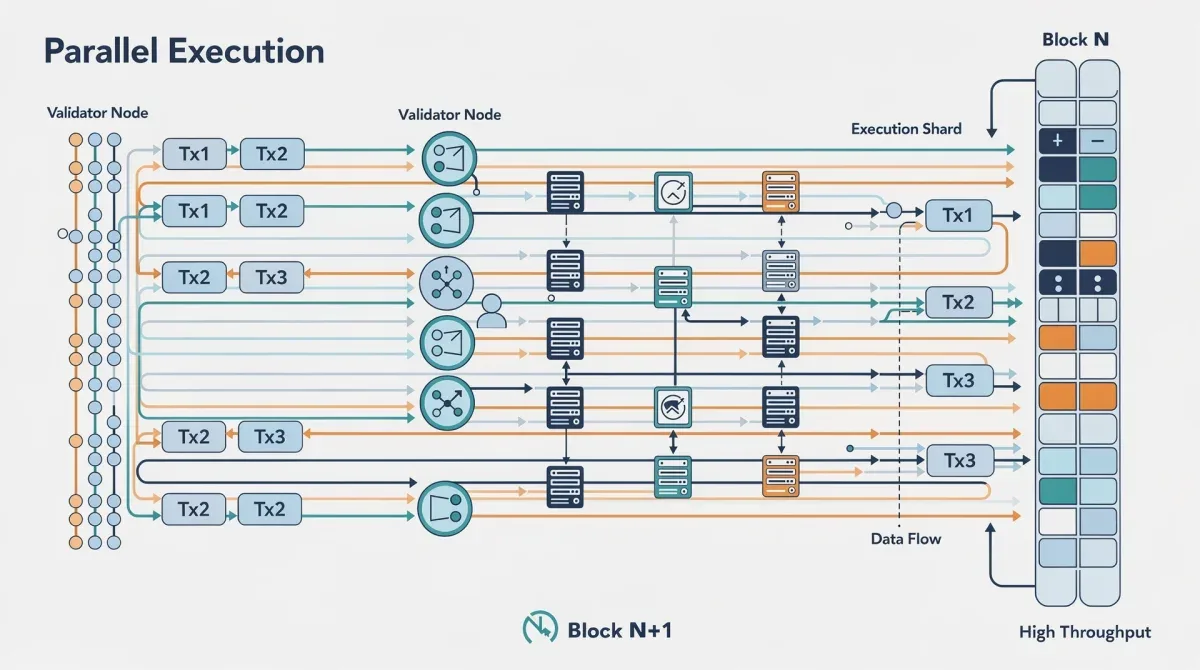
Monad's parallel execution and deferred execution
Monad introduces two key innovations: parallel execution and deferred execution. Parallel execution allows the network to process independent transactions concurrently, dramatically increasing throughput. Deferred execution, on the other hand, allows for the speculative execution of transactions, where results are computed before final confirmation, further optimizing the block production process.
- MonadBFT: A custom Byzantine Fault Tolerant consensus mechanism.
- Parallel Execution: Concurrent processing of independent transactions.
- Monad Diffusion: An optimized peer-to-peer network for fast block propagation.
- Deferred Execution: Speculative transaction processing for efficiency.
By implementing these features, Monad aims to achieve a significantly higher transaction per second (TPS) rate than existing EVM chains, with a target of 10,000+ TPS and sub-second finality. This level of performance, combined with EVM compatibility, positions Monad as a powerful alternative for developers looking to build scalable dApps without rewriting their existing Solidity codebases.
Monad's commitment to EVM compatibility is a strategic move, lowering the barrier to entry for developers and enabling a seamless migration for existing dApps. This approach could accelerate the adoption of high-performance blockchain technology by leveraging the existing developer community and liquidity within the Ethereum ecosystem. The platform seeks to offer the best of both worlds: the robust security and developer familiarity of EVM, coupled with the speed and scalability traditionally associated with non-EVM chains.
Benchmarking sub-second finality: metrics and challenges
Benchmarking sub-second finality requires a precise understanding of various metrics beyond simple transaction per second (TPS). While TPS indicates throughput, finality measures the time it takes for a transaction to be irreversibly confirmed on the blockchain. For Solana and Monad, accurately measuring and comparing these metrics is crucial for evaluating their real-world performance.
Key metrics include latency to finality, transaction throughput, and network stability under load. Latency to finality is arguably the most critical for sub-second performance, indicating the actual user experience. Challenges in benchmarking include ensuring consistent network conditions, preventing Sybil attacks during testing, and accounting for varying geographical distances between nodes.
Critical metrics for performance evaluation
Evaluating performance effectively requires a multi-faceted approach, considering not just raw speed but also the underlying stability and cost implications.
- Time to Finality: The duration from transaction submission to irreversible confirmation.
- Transaction Throughput (TPS): The number of transactions processed per second.
- Network Latency: Delay in communication between nodes.
- Decentralization Index: Distribution of validator power and node count.
- Transaction Cost: Fees associated with processing transactions.
Both Solana and Monad aim for impressive TPS figures, but their true value proposition in 2026 will be defined by their consistent ability to deliver sub-second finality reliably, even during periods of high network congestion. This requires robust consensus mechanisms and efficient block propagation protocols that can withstand real-world pressures. For example, a network might claim high TPS, but if finality takes several seconds, it undermines the user experience for time-sensitive applications.
Furthermore, the environmental impact and energy consumption of these high-performance networks are increasingly scrutinized. Benchmarking must also consider the energy efficiency of their consensus mechanisms, ensuring that speed does not come at an unsustainable cost. The ongoing development and optimization efforts in both Solana and Monad are constantly addressing these multifaceted challenges, striving for a balanced approach to performance, security, and sustainability.
Solana vs Monad: architectural distinctions in 2026
The architectural differences between Solana and Monad are fundamental, shaping their respective strengths and weaknesses in the pursuit of sub-second finality. Solana, with its established Proof of History and parallel execution via Sealevel, has already demonstrated high throughput. Monad, while newer, aims to achieve similar or even greater performance with full EVM compatibility through its own parallel and deferred execution models.
Solana's design prioritizes raw speed and throughput, often requiring specialized hardware for validators. This design choice, while enabling incredible performance, has sometimes led to concerns about network stability and potential centralization. Monad, conversely, is building on the familiar EVM framework, which could make it more accessible for developers but introduces its own set of challenges in achieving extreme performance without compromising compatibility.
Key differences in design philosophy
Their distinct approaches reflect different priorities and trade-offs in blockchain design.
- Consensus Mechanism: Solana uses PoH + Tower BFT; Monad uses MonadBFT.
- Execution Environment: Solana has its custom Sealevel runtime; Monad is fully EVM-compatible.
- Hardware Requirements: Solana validators typically require high-end hardware; Monad aims for more optimized requirements.
- Maturity: Solana is a more mature network with extensive real-world testing; Monad is an emerging player.
The choice between Solana and Monad for developers in 2026 will likely depend on their specific needs. Projects prioritizing maximum raw performance and willing to adapt to a non-EVM environment might lean towards Solana. Those seeking high performance coupled with seamless integration into the existing EVM ecosystem, leveraging familiar tools and smart contracts, might find Monad more appealing. The ability of Monad to achieve Solana-level performance while maintaining EVM compatibility would be a significant disruptive force.
Both networks are actively evolving, and their architectural distinctions will continue to be refined. Solana is working on improving decentralization and network resilience, while Monad is focused on rigorously testing and optimizing its novel execution models. The competition will ultimately benefit the broader blockchain ecosystem, pushing the boundaries of what's possible in terms of speed and scalability.
Implications for decentralized applications and user experience
The achievement of consistent sub-second finality by platforms like Solana and Monad has profound implications for the development and adoption of decentralized applications (dApps) and the overall user experience. This level of performance fundamentally changes what is possible on a blockchain, moving beyond niche financial instruments to mainstream applications that demand instant feedback and smooth interactions.
Imagine a decentralized social media platform where posts are instantly published and reactions are immediate, without any noticeable lag. Or a high-stakes online game where every action is recorded and confirmed in real-time, eliminating frustrating delays. Sub-second finality transforms these theoretical possibilities into practical realities, making dApps feel as responsive and intuitive as their centralized counterparts.

Impact on various sectors
The benefits of rapid finality extend across numerous industries, catalyzing innovation in unexpected ways.
- DeFi: Enables high-frequency trading, instant lending, and real-time collateral management.
- Gaming: Facilitates seamless in-game transactions, dynamic NFT interactions, and competitive gameplay.
- Payments: Allows for instant, low-cost global remittances and point-of-sale transactions.
- Supply Chain: Provides real-time tracking and verification of goods.
- Identity Management: Enables quick authentication and verifiable credentials.
For users, this means a significantly improved experience. No more waiting for transactions to confirm, no more uncertainty about the status of a payment or an asset transfer. The friction often associated with blockchain interactions diminishes, leading to greater user satisfaction and a lower barrier to entry for new users. Developers, in turn, gain the freedom to design more complex and interactive applications, knowing that the underlying network can support their ambitions.
The competition between Solana and Monad to deliver superior sub-second finality is not just about technical bragging rights; it's about shaping the future of the internet. By enabling a truly responsive and scalable decentralized infrastructure, these platforms are paving the way for a new era of dApps that can compete directly with, and potentially surpass, the capabilities of traditional web services. The ultimate winner will be the platform that not only delivers speed but also maintains robust security, decentralization, and ease of use, fostering a thriving ecosystem.
The future landscape of high-performance blockchains in 2026
Looking ahead to 2026, the landscape of high-performance blockchains will undoubtedly be more competitive and sophisticated. The advancements pioneered by Solana and Monad in achieving sub-second finality are setting new industry standards, forcing other Layer 1 and Layer 2 solutions to innovate or risk becoming obsolete. This intensified competition will drive further improvements in scalability, security, and developer experience across the entire ecosystem.
We can expect to see a greater focus on interoperability, as even the fastest blockchains will need to seamlessly connect with others to facilitate a truly global decentralized web. Solutions like cross-chain bridges and atomic swaps will become more robust and user-friendly, allowing assets and data to flow freely between high-performance networks like Solana and EVM-compatible chains like Monad.
Emerging trends and challenges
The rapid pace of innovation also brings new trends and challenges that the industry must address.
- Cross-chain Interoperability: Seamless asset and data transfer between different blockchains.
- Enhanced Security Models: New cryptographic techniques to protect against advanced threats.
- Sustainable Consensus: Development of more energy-efficient validation methods.
- Developer Tooling: Improved SDKs and frameworks to simplify dApp development.
- Regulatory Clarity: Evolving legal frameworks to support blockchain innovation.
The challenge for Solana and Monad, beyond achieving raw performance, will be to maintain decentralization and security as they scale. A highly centralized, fast blockchain defeats the core purpose of decentralization. Therefore, continuous innovation in consensus mechanisms, validator incentives, and community governance will be crucial for their long-term success and trustworthiness. The integration of advanced zero-knowledge proofs and other privacy-enhancing technologies will also become more prevalent, addressing growing concerns about data privacy on public ledgers.
Ultimately, the future of high-performance blockchains in 2026 will be characterized by a relentless pursuit of speed, security, and user-centric design. Solana and Monad are at the forefront of this evolution, pushing the boundaries of what decentralized technology can achieve. Their ongoing architectural innovations and competitive drive are not just about individual platform success, but about collectively advancing the capabilities of the entire blockchain industry towards a more efficient, inclusive, and decentralized future.
| Key Aspect | Description |
|---|---|
| Sub-Second Finality | Transaction confirmation under one second, crucial for mainstream dApp adoption. |
| Solana's Architecture | Utilizes Proof of History (PoH) and parallel execution (Sealevel) for high throughput. |
| Monad's Approach | EVM-compatible with parallel and deferred execution for enhanced performance. |
| Implications | Enables responsive dApps, real-time payments, and advanced DeFi applications. |
Frequently asked questions about Solana and Monad
What is sub-second finality in blockchain, and why is it important?▼Sub-second finality means a blockchain transaction is confirmed irreversibly in under a second. It's crucial for mainstream adoption, enabling real-time applications like high-frequency trading, gaming, and instant payments, significantly enhancing user experience and dApp capabilities.
How does Solana achieve its high transaction speeds?▼Solana utilizes several innovations, primarily Proof of History (PoH) for a verifiable transaction order and Sealevel, a parallel smart contracts runtime. These allow concurrent transaction processing and faster consensus, leading to high throughput and near-instant finality.
What makes Monad's architecture unique compared to Solana?▼Monad distinguishes itself by offering full EVM compatibility alongside high performance. It employs parallel and deferred execution models to process transactions concurrently, aiming to provide Solana-level speed within the familiar Ethereum Virtual Machine ecosystem for developers.
What are the main challenges in benchmarking sub-second finality?▼Benchmarking challenges include ensuring consistent network conditions, preventing Sybil attacks, and accurately measuring latency to finality beyond just TPS. It also involves accounting for network stability under load and the geographical distribution of nodes to reflect real-world performance.
How will sub-second finality impact decentralized applications (dApps) in 2026?▼Sub-second finality will revolutionize dApps by enabling real-time interactions, making them as responsive as centralized applications. This will foster innovation in DeFi, gaming, payments, and supply chain management, driving broader adoption and a superior user experience.
Conclusion
The architectural innovations championed by Solana and Monad are fundamentally reshaping the capabilities of blockchain technology, particularly in the critical domain of sub-second transaction finality. Solana's battle-tested Proof of History and parallel execution offer a robust framework for speed, while Monad's pursuit of EVM compatibility coupled with advanced execution models promises a powerful, accessible alternative. As we progress into 2026, the ongoing competition and advancements from both platforms will not only drive further technical excellence but also unlock unprecedented possibilities for decentralized applications, making blockchain technology more integrated and impactful in our daily lives.
