US Stakers: 8.4% Real Yield on Ethereum Layer-2 in 2026
US stakers are securing an impressive 8.4% real yield on Ethereum Layer-2 protocols by 2026 by strategically utilizing decentralized finance opportunities, enhanced scalability solutions, and innovative staking mechanisms to maximize their returns.
Understanding ethereum layer-2 staking for real yield in 2026 is crucial for US investors seeking substantial returns. This evolving landscape offers innovative avenues for capital growth, moving beyond traditional financial paradigms.
The rise of Ethereum Layer-2 protocols
Ethereum's transition to a Proof-of-Stake (PoS) consensus mechanism has dramatically reshaped the blockchain landscape, particularly for stakers. However, the mainnet's inherent limitations in scalability and transaction costs has spurred the rapid development and adoption of Layer-2 solutions. These protocols are not just supplemental; they are becoming essential infrastructure, enabling Ethereum to handle a significantly higher volume of transactions at a fraction of the cost.
The innovation within Layer-2s extends beyond simple transaction processing. They introduce new paradigms for decentralized applications (dApps) and financial primitives, creating a more robust and accessible ecosystem. For US stakers, this means unlocking opportunities that were previously constrained by the mainnet's throughput, allowing for more dynamic and profitable engagement with the Ethereum network.
Understanding Layer-2 scaling solutions
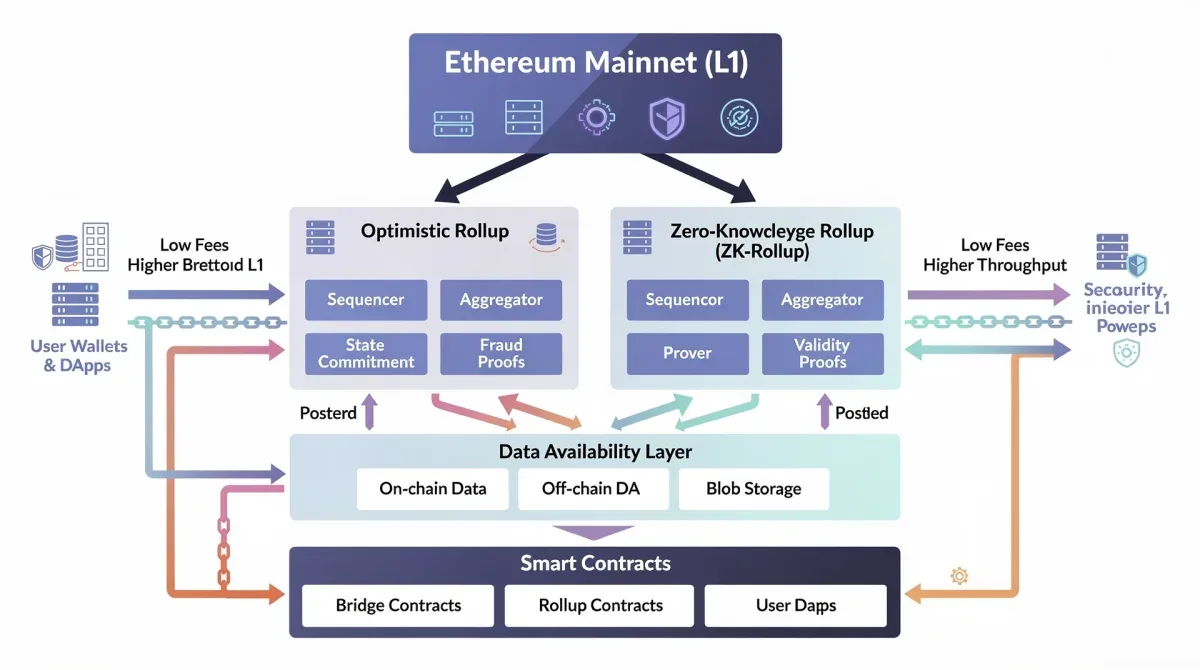
Layer-2 solutions operate by processing transactions off the main Ethereum chain, bundling them, and then submitting a compressed proof or summary back to Layer-1. This approach drastically reduces the load on the mainnet, leading to faster finality and lower gas fees. Several types of Layer-2 technologies have emerged, each with distinct characteristics and use cases.
- Optimistic Rollups: These assume transactions are valid by default and only run computations if a challenge is issued. They offer high scalability but have a challenge period (typically 7 days) for withdrawals.
- Zero-Knowledge (ZK) Rollups: These prove the validity of transactions cryptographically off-chain, submitting a validity proof to Layer-1. They offer instant finality and strong security guarantees, albeit with higher computational complexity for proof generation.
- State Channels: Allow participants to conduct multiple transactions off-chain, only interacting with the mainnet to open and close the channel. Ideal for high-frequency, peer-to-peer interactions.
- Plasma: A framework for building scalable child chains, each with its own consensus mechanism, anchored to the Ethereum mainnet.

The choice of Layer-2 protocol often depends on the specific needs of the dApp or staking strategy. For instance, ZK-rollups are gaining traction for their security and efficiency, while optimistic rollups remain popular for their ease of implementation and broader compatibility with existing Ethereum tools. As these technologies mature, their integration into the broader DeFi ecosystem will only deepen.
In conclusion, the evolution of Ethereum Layer-2 protocols is a critical development for the entire crypto space, especially for stakers. These solutions address core scalability challenges, paving the way for a more efficient, cost-effective, and ultimately, more profitable staking environment. The diversity of Layer-2 technologies also ensures that the ecosystem remains adaptable and resilient, capable of meeting various demands.
Staking mechanics on Layer-2s for real yield
Staking on Layer-2 protocols differs significantly from traditional Ethereum mainnet staking. While the underlying principle of locking up tokens to support network operations and earn rewards remains, Layer-2s introduce unique mechanisms and opportunities for enhanced yield. These protocols are designed to optimize capital efficiency and reduce operational costs, directly impacting the 'real yield' achievable by stakers.
Real yield, in this context, refers to the actual returns received after accounting for all costs, such as gas fees, protocol fees, and impermanent loss in certain DeFi strategies. Layer-2s inherently reduce gas fees, which is a major factor in improving real yield, especially for smaller stakers or those engaging in frequent re-staking activities.
Leveraging liquid staking derivatives (LSDs)
One of the most impactful innovations for Layer-2 staking is the proliferation of Liquid Staking Derivatives (LSDs). These tokens represent staked ETH on the mainnet but are liquid and can be used within Layer-2 DeFi protocols. This allows stakers to earn staking rewards from Layer-1 while simultaneously participating in yield-generating activities on Layer-2s.
- Increased Capital Efficiency: LSDs unlock liquidity, preventing capital from being idle while staked.
- Layer-2 DeFi Integration: LSDs can be used as collateral for loans, provided as liquidity to decentralized exchanges (DEXs), or staked in other Layer-2 protocols to earn additional yield.
- Compounding Returns: The ability to re-invest LSDs into other yield farms on Layer-2s allows for compounding effects, significantly boosting overall returns.
The synergy between LSDs and Layer-2s creates a powerful mechanism for maximizing real yield. For example, a US staker might stake ETH on the mainnet to receive stETH (Lido's LSD). They can then bridge this stETH to an Arbitrum or Optimism Layer-2, where they can deposit it into a lending protocol to earn interest, or provide it as liquidity to a stETH/ETH pair on a DEX, earning trading fees and potentially additional protocol tokens. This multi-layered approach to yield generation is a cornerstone of achieving high real yields in 2026.
In essence, Layer-2 staking mechanisms are evolving to be more capital-efficient and flexible. By reducing transaction costs and enabling the use of liquid staking derivatives, these protocols allow US stakers to engage in complex, yield-maximizing strategies that were previously impractical on the Ethereum mainnet. This adaptability is key to securing substantial real yields.
Strategic yield farming on Layer-2s
Yield farming on Ethereum Layer-2 protocols presents a dynamic and often lucrative avenue for US stakers to amplify their returns beyond basic staking rewards. These strategies leverage the lower transaction costs and faster speeds of Layer-2s to execute complex DeFi maneuvers that would be prohibitively expensive on the mainnet. The goal is to maximize the 'real yield' by actively participating in various decentralized finance applications.
Successful yield farming requires a deep understanding of protocol mechanics, risk assessment, and market trends. It's not a set-and-forget strategy; rather, it involves continuous monitoring and adaptation to optimize returns and mitigate potential losses. The inherent design of Layer-2s facilitates this active management, making it more accessible for a broader range of investors.
Popular yield farming strategies
Several strategies are commonly employed by sophisticated US stakers to generate high real yields on Layer-2s:
- Liquidity Provision (LP) with Incentives: Providing liquidity to decentralized exchanges (DEXs) on Layer-2s like Uniswap v3 on Arbitrum or Velodrome on Optimism can earn trading fees. Many protocols also offer additional token incentives to LPs, boosting overall APRs.
- Lending and Borrowing Protocols: Platforms such as Aave and Compound, deployed on Layer-2s, allow users to lend out their crypto assets for interest or borrow against them. Stakers can deposit stablecoins or wrapped ETH (wETH) to earn yield, or borrow against their staked assets to pursue other yield opportunities.
- Aggregated Staking Platforms: Services that pool assets and deploy them across various yield-generating strategies on Layer-2s, often optimizing for the highest returns while abstracting away complexity for the user. These can involve a mix of single-asset staking, LP farming, and lending.
- Delta-Neutral Strategies: Advanced strategies that aim to minimize exposure to price fluctuations by simultaneously holding long and short positions, often involving options or perpetual futures, while still earning yield from funding rates or basis trading on Layer-2 derivatives platforms.
The efficiency of Layer-2s in processing transactions makes these strategies more viable. For instance, adjusting liquidity positions or rebalancing portfolios to chase higher yields becomes economically feasible when gas fees are minimal. This agility is a key differentiator from Layer-1 yield farming, allowing for more frequent optimization and higher potential returns. However, it's crucial to remember that higher potential returns often come with increased risk, including smart contract vulnerabilities, impermanent loss, and the volatility of incentive tokens.
In summary, strategic yield farming on Layer-2s is a powerful tool for US stakers to enhance their real yield. By combining various DeFi primitives with the efficiencies of Layer-2 technology, investors can construct sophisticated strategies designed to maximize returns. However, due diligence and continuous risk management are paramount to navigating this complex yet rewarding landscape successfully.
Evaluating risk and security on Layer-2s
While Ethereum Layer-2 protocols offer compelling opportunities for enhanced real yield, it is critical for US stakers to thoroughly understand and evaluate the inherent risks and security considerations. The decentralized nature of these protocols, combined with their nascent technology, means that vigilance and informed decision-making are paramount. A comprehensive understanding of potential vulnerabilities is essential for protecting capital and ensuring sustainable returns.
Security on Layer-2s is a multi-faceted issue, encompassing smart contract risks, bridge security, centralization risks, and the overall maturity of the protocol. Ignoring these factors can lead to significant financial losses, even when pursuing seemingly high-yield opportunities.
Common risks and mitigation strategies
Several key risks are associated with staking and yield farming on Layer-2 protocols:
- Smart Contract Vulnerabilities: Like any blockchain-based application, Layer-2 protocols and the dApps built on them are susceptible to bugs or exploits in their smart contracts. These can lead to loss of funds. Mitigation involves choosing protocols that have undergone rigorous audits by reputable firms and have a strong track record.
- Bridge Security: Moving assets between Layer-1 and Layer-2 typically involves a bridge. These bridges are often centralized or semi-centralized points of failure and have been targets for hacks. Using well-established, audited bridges and understanding their security models is crucial.
- Centralization Risks: Some Layer-2 solutions may have centralized components, such as sequencers or fraud provers, which could introduce censorship or single points of failure. Researching the decentralization roadmap of a Layer-2 is important.
- Impermanent Loss: For liquidity providers in DEXs, impermanent loss occurs when the price ratio of tokens in a liquidity pool changes after deposit. While not a direct loss, it can reduce the value of LP tokens compared to simply holding the assets. Understanding how to manage or hedge against impermanent loss is vital for LP strategies.
- Rug Pulls and Scams: The DeFi space, including Layer-2s, is not immune to malicious projects designed to defraud users. Thorough research into the team, community, and transparency of a project is essential before committing funds.
To mitigate these risks, US stakers should adopt a multi-pronged approach. Diversifying investments across multiple Layer-2 protocols and strategies can help spread risk. Staying informed about security advisories, bug bounties, and community discussions is also critical. Furthermore, understanding the technical underpinnings of each Layer-2, including its dispute resolution mechanisms (for optimistic rollups) or validity proof generation (for ZK-rollups), empowers stakers to make more informed decisions.
In conclusion, while the allure of high real yields on Layer-2s is strong, a cautious and informed approach to risk and security is non-negotiable. By actively researching, diversifying, and staying updated on protocol developments, US stakers can navigate the Layer-2 landscape more safely, protecting their investments while pursuing their financial goals.
Regulatory landscape for US stakers in 2026
The regulatory environment for cryptocurrency in the United States is continuously evolving, and by 2026, it is expected to have a significant impact on how US stakers engage with Ethereum Layer-2 protocols for real yield. Navigating this landscape effectively will be crucial for compliance and long-term success. Understanding potential regulations and their implications allows stakers to prepare and adapt their strategies proactively.
Regulatory clarity, or lack thereof, can influence everything from tax obligations to the availability of certain DeFi products and services. US regulators, including the SEC, CFTC, and Treasury, are increasingly scrutinizing the crypto space, aiming to establish frameworks that protect consumers and maintain financial stability without stifling innovation.
Anticipated regulatory developments and compliance
Several key regulatory areas are likely to affect US stakers by 2026:
- Taxation of Staking Rewards: The IRS has indicated that staking rewards are generally taxable as income when received. Clarity on whether these are taxed as ordinary income or capital gains, and at what specific point (when earned vs. when sold), continues to be refined. Stakers will need robust record-keeping for all staking activities across Layer-1 and Layer-2.
- Classification of Tokens: The debate over whether certain crypto assets, particularly those involved in yield-generating activities, constitute securities remains a central issue. If Layer-2 tokens or LSDs are classified as securities, they could be subject to stringent registration and disclosure requirements, impacting their availability and trading.
- AML/KYC Requirements: Increased Anti-Money Laundering (AML) and Know Your Customer (KYC) regulations are likely to extend further into the DeFi space, potentially impacting decentralized exchanges and lending protocols operating on Layer-2s. This could necessitate greater identity verification for users engaging with these platforms.
- Stablecoin Regulation: The regulation of stablecoins, often a cornerstone of DeFi yield farming, is a priority for US policymakers. Clear rules around stablecoin issuance and reserves could bring stability but also impose new compliance burdens on protocols and users.
For US stakers, staying informed about these regulatory shifts is not just about avoiding penalties; it's about making strategic decisions. For example, understanding potential tax liabilities can influence decisions on when to realize rewards or how to structure yield farming operations. Engaging with compliant services and seeking professional tax and legal advice will become increasingly important. Some protocols may also choose to geo-fence US users if regulatory burdens become too onerous, highlighting the need for vigilance.
Ultimately, the regulatory landscape for US stakers in 2026 will likely be more defined but also more restrictive in certain areas. Proactive engagement with compliance, robust record-keeping, and an awareness of evolving legal interpretations will be essential for those looking to secure high real yields on Ethereum Layer-2 protocols.
Future outlook and technological advancements
The trajectory of Ethereum Layer-2 protocols and their impact on staking yields is deeply intertwined with ongoing technological advancements and the broader evolution of the blockchain ecosystem. Looking towards 2026, several key developments are expected to further optimize Layer-2 performance, enhance user experience, and create even more sophisticated opportunities for US stakers to secure substantial real yields.
These advancements are not merely incremental; they represent fundamental shifts in how Layer-2s operate, how they interact with Layer-1, and how they integrate into the wider decentralized finance landscape. Staying abreast of these changes is crucial for any staker aiming to maintain a competitive edge and maximize their returns.
Key innovations shaping Layer-2s
Several technological advancements are poised to redefine Layer-2 staking and yield generation:
- Proto-Danksharding and EIP-4844: These Ethereum upgrades, particularly EIP-4844 (Proto-Danksharding), will significantly reduce the cost of storing rollup data on the Ethereum mainnet. This will directly translate to even lower transaction fees on Layer-2s, making yield farming and frequent re-staking strategies even more economically viable and boosting real yields.
- Shared Sequencers and Decentralization: Efforts to decentralize Layer-2 sequencers (the entities that order and batch transactions) are ongoing. This will reduce centralization risks, improve censorship resistance, and enhance the overall security and trustlessness of Layer-2 networks, making them more attractive for institutional and large-scale stakers.
- Cross-Rollup Communication: Improved and more seamless communication between different Layer-2 protocols will unlock new possibilities for capital efficiency. This could enable complex DeFi strategies that span multiple Layer-2s without needing to bridge back to Layer-1, reducing costs and latency.
- Account Abstraction: This innovation aims to make crypto wallets more user-friendly and feature-rich, enabling functionalities like gas fee payment in any token, batching multiple transactions into one, and social recovery. For stakers, this means a smoother, more intuitive experience when interacting with Layer-2 DeFi protocols.
The combination of these advancements points towards a future where Layer-2s are not just faster and cheaper, but also more secure, decentralized, and user-friendly. This will attract a wider range of participants, from retail investors to institutional players, further deepening liquidity and creating a more robust environment for yield generation. The competition among Layer-2s will also drive innovation, leading to better products and services for stakers.
In conclusion, the future outlook for Ethereum Layer-2 protocols is one of continuous innovation and expansion. These technological advancements are set to lower barriers to entry, enhance security, and significantly improve the efficiency of yield-generating activities. For US stakers, this means an increasingly sophisticated and potentially more profitable landscape for securing real yields in the coming years.
Maximizing your 8.4% real yield potential
Achieving the projected 8.4% real yield on Ethereum Layer-2 protocols by 2026 is an ambitious yet attainable goal for US stakers, provided they adopt a strategic and informed approach. This involves not only understanding the technical landscape but also continuously optimizing strategies, managing risk, and staying ahead of market trends. Maximizing yield potential is an ongoing process that requires active participation and adaptability.
The confluence of lower transaction costs, innovative DeFi primitives, and upcoming Ethereum upgrades creates a fertile ground for high returns. However, simply participating is not enough; a methodical approach to capital deployment and risk management is essential to truly capitalize on these opportunities.
Actionable steps for US stakers
- Diversify Across Layer-2s and Protocols: Instead of concentrating all capital in one Layer-2 or one DeFi protocol, spread investments across multiple robust and audited platforms. This mitigates smart contract risk and allows for exposure to various yield opportunities.
- Leverage Liquid Staking Derivatives (LSDs) Effectively: Use LSDs to maintain liquidity while earning Layer-1 staking rewards, then deploy these LSDs into Layer-2 lending, liquidity provision, or aggregated staking platforms to earn additional yield. Continuously monitor the highest yielding opportunities for LSDs.
- Stay Informed on Protocol Updates and Airdrops: Many Layer-2 protocols offer token incentives or potential airdrops for early adopters and active participants. Staying engaged with community channels and protocol announcements can unlock additional value.
- Monitor Gas Fees and Transaction Costs: Even on Layer-2s, gas fees can fluctuate. Optimize transaction timing for lower fees, especially for frequent re-staking or rebalancing of positions, to preserve real yield.
- Understand and Manage Impermanent Loss: For those providing liquidity, understanding the dynamics of impermanent loss is crucial. Consider using concentrated liquidity pools (like Uniswap v3) with stable pairs or employing delta-neutral strategies where appropriate.
- Maintain Detailed Records for Tax Compliance: Given the evolving regulatory landscape, meticulous record-keeping of all staking rewards, yield farming profits, and transaction costs is essential for accurate tax reporting. Consult with a crypto-savvy tax professional.
The 8.4% real yield figure represents an achievable benchmark for those who are diligent and strategic. It's a testament to the compounding power of DeFi on Layer-2s when executed thoughtfully. As the ecosystem matures, new tools and strategies will undoubtedly emerge, further refining the path to optimized returns. Continuous learning and adaptation will be the hallmarks of successful US stakers in 2026.
In conclusion, maximizing real yield potential on Ethereum Layer-2 protocols requires a blend of technical understanding, strategic diversification, and proactive risk management. By following these actionable steps, US stakers can position themselves to effectively capitalize on the innovative opportunities presented by the evolving Layer-2 landscape, securing substantial returns in the coming years.
| Key Aspect | Brief Description |
|---|---|
| Layer-2 Efficiency | Reduces gas fees and increases transaction speed, boosting real yield for stakers. |
| Liquid Staking Derivatives | Unlock staked capital for additional yield farming opportunities on Layer-2s. |
| Strategic Yield Farming | Engaging in LP, lending, and aggregated strategies on Layer-2s for compounded returns. |
| Risk & Compliance | Crucial to assess smart contract risks and navigate evolving US regulations for sustainable returns. |
Frequently asked questions about Layer-2 staking
What is 'real yield' in the context of Ethereum Layer-2 staking?▼Real yield refers to the actual returns a staker receives after accounting for all associated costs, such as transaction fees, protocol fees, and potential impermanent loss. On Layer-2s, reduced gas fees significantly improve real yield compared to Layer-1 staking, making more frequent and complex yield-generating strategies economically viable for US stakers.
How do Liquid Staking Derivatives (LSDs) enhance Layer-2 staking yields?▼LSDs represent staked ETH on the mainnet but remain liquid, allowing them to be deployed in various DeFi protocols on Layer-2s. This enables stakers to earn Layer-1 staking rewards while simultaneously generating additional yield through lending, liquidity provision, or other strategies, effectively compounding returns and maximizing capital efficiency.
What are the main risks associated with Layer-2 staking and yield farming?▼Key risks include smart contract vulnerabilities, bridge security exploits, centralization risks within some Layer-2 protocols, impermanent loss for liquidity providers, and the potential for rug pulls or scams. Mitigating these requires thorough research, diversification, and staying updated on security audits and community discussions for chosen protocols.
How will US regulations impact Layer-2 staking by 2026?▼By 2026, US regulations are expected to bring more clarity on taxation of staking rewards, potential classification of certain tokens as securities, and increased AML/KYC requirements. These changes will necessitate robust record-keeping, potential legal and tax advice, and an awareness that some protocols might geo-fence US users if compliance burdens are too high.
What technological advancements will drive Layer-2 yields in the future?▼Future advancements like Proto-Danksharding (EIP-4844) will significantly reduce Layer-2 transaction costs. Additionally, shared sequencers, enhanced cross-rollup communication, and account abstraction will improve decentralization, capital efficiency, and user experience, all contributing to higher and more accessible real yields for US stakers on Ethereum Layer-2s.
Conclusion
The journey to securing an 8.4% real yield on Ethereum Layer-2 protocols by 2026 for US stakers is a testament to the dynamic evolution of decentralized finance. By strategically leveraging the inherent efficiencies of Layer-2 solutions, innovative liquid staking derivatives, and sophisticated yield farming techniques, investors can unlock substantial returns. While the path is fraught with technical complexities and an evolving regulatory landscape, a diligent and informed approach to risk management and continuous learning will undoubtedly position US stakers at the forefront of this lucrative frontier. The future of staking is increasingly intertwined with these scalable solutions, promising a more accessible and profitable ecosystem for all.
