ZK-Rollups vs. Optimistic Rollups: Cut Smart Contract Costs by 88%
ZK-Rollups and Optimistic Rollups are pivotal Layer-2 scaling solutions that bundle transactions off-chain to significantly reduce smart contract execution costs, with some implementations achieving up to an 88% reduction, thereby enhancing blockchain efficiency and accessibility.
Understanding the intricacies of ZK-Rollups vs. Optimistic Rollups: How Layer-2 Architecture Cuts Smart Contract Execution Costs by 88% is becoming increasingly vital for anyone navigating the evolving landscape of blockchain technology. These innovative solutions promise to revolutionize how we interact with decentralized applications, making them faster, more affordable, and accessible to a wider audience. But what exactly sets them apart, and how do they deliver such significant cost savings?
The pressing need for Layer-2 scaling solutions
The rise of decentralized applications (dApps) has exposed a critical bottleneck in many foundational blockchain networks, most notably Ethereum. As usage surged, transaction fees, often referred to as 'gas fees,' skyrocketed, and transaction processing times lengthened considerably. This scalability challenge severely hinders mainstream adoption, making everyday interactions with smart contracts prohibitively expensive and frustratingly slow for many users.
Addressing these limitations is paramount for the continued growth and utility of blockchain technology. Without effective scaling, the promise of a decentralized, efficient internet remains largely unfulfilled. Layer-2 solutions emerge as a powerful answer, building on top of existing Layer-1 blockchains to process transactions more efficiently without compromising the underlying network's security.
The core problem: Ethereum's scalability conundrum
Ethereum, despite its pioneering role in smart contracts, faces inherent design trade-offs that prioritize decentralization and security over raw transaction throughput. Each transaction must be processed and verified by every node on the network, leading to a bottleneck when demand is high. This 'gas crisis' has driven developers and users alike to seek alternative, more scalable architectures.
- High transaction fees: During periods of network congestion, gas fees can surge to unsustainable levels, pricing out many potential users and applications.
- Slow transaction finality: Confirming transactions can take minutes, or even longer, impacting user experience and application responsiveness.
- Limited throughput: The network can only process a finite number of transactions per second, leading to backlogs and delays.
These issues underscore why Layer-2 solutions are not just an improvement but a necessity for Ethereum and similar blockchains to achieve their full potential. They offer a pathway to scale while preserving the core tenets of decentralization and security that make these networks valuable.

In essence, Layer-2 scaling solutions are designed to offload a significant portion of transaction processing from the main blockchain. By doing so, they drastically reduce the computational burden on the Layer-1 network, leading to lower fees and faster processing. This approach is fundamental to making smart contract interactions more economical and accessible, paving the way for broader adoption of dApps and decentralized finance (DeFi).
Understanding Layer-2 architecture: How rollups work
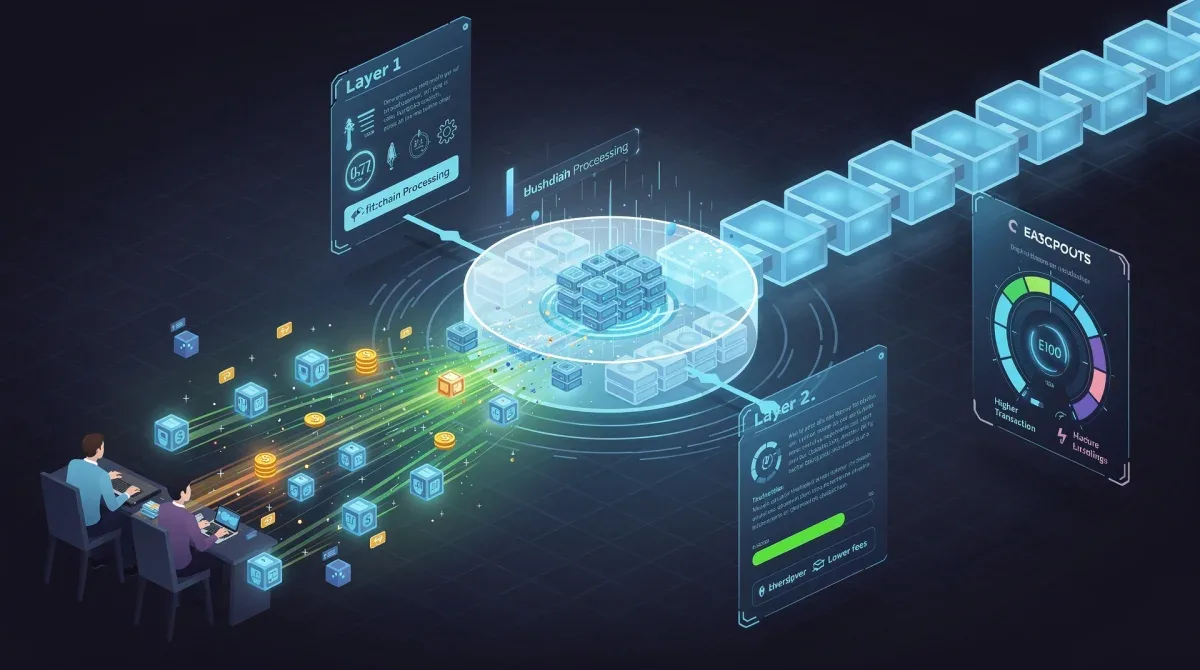
Layer-2 scaling solutions, particularly rollups, operate by taking transactions off the main blockchain (Layer-1), processing them in a separate environment, and then 'rolling up' or bundling hundreds or thousands of these transactions into a single, compact data packet. This bundled packet is then submitted back to the Layer-1 blockchain for final settlement. This ingenious method significantly reduces the amount of data that the main chain needs to process and store, leading to dramatic improvements in scalability and cost efficiency.
The fundamental principle behind rollups is to execute computations off-chain while maintaining the security guarantees of the Layer-1 blockchain. Instead of every node on the main chain verifying every single transaction, only the aggregated data of many transactions is verified. This drastically cuts down on gas fees because the cost of processing a single aggregated transaction is amortized across all the individual transactions it contains.
The mechanism of transaction bundling
Imagine a busy highway (Layer-1) where every car (transaction) has to pay a toll individually. Rollups introduce a system where many cars merge into a large bus (the bundled transaction), and only the bus pays a single toll. This not only speeds up traffic but also reduces the cost per passenger. In the blockchain context, this means that instead of paying gas for each individual smart contract execution, users contribute to a much smaller fee for the bundled transaction.
- Off-chain execution: Transactions are executed on a separate Layer-2 network, reducing congestion on the Layer-1.
- Data compression: Transaction data is compressed before being sent to Layer-1, further minimizing storage and processing requirements.
- Batch submission: Multiple transactions are grouped into a single batch, and only this batch is submitted to the main chain.
This batching and compression are critical to achieving the stated cost reductions. By reducing the data footprint and the number of on-chain operations, rollups unlock a new level of efficiency for blockchain networks.
Ultimately, the beauty of rollup technology lies in its ability to inherit the security of the underlying Layer-1 blockchain. While transactions are processed off-chain, their integrity and correctness are still ultimately rooted in the robust security mechanisms of the main chain. This balance between scalability and security is what makes rollups such a promising solution for the future of decentralized applications.
ZK-Rollups: Cryptographic certainty and instant finality
ZK-Rollups represent a sophisticated class of Layer-2 scaling solutions that leverage zero-knowledge proofs to achieve unparalleled security and efficiency. Unlike other rollup technologies, ZK-Rollups provide cryptographic certainty that all transactions within a batch are valid, without revealing any sensitive information about the individual transactions themselves. This is a powerful distinction, offering immediate finality and a higher degree of trust.
The core innovation of ZK-Rollups lies in their use of zero-knowledge succinct non-interactive arguments of knowledge (zk-SNARKs) or zero-knowledge scalable transparent arguments of knowledge (zk-STARKs). These cryptographic proofs allow a prover to convince a verifier that a statement is true, without revealing any information beyond the truth of the statement itself. In the context of rollups, the 'statement' is that a batch of off-chain transactions is valid according to the Layer-1 rules.
How zero-knowledge proofs ensure security
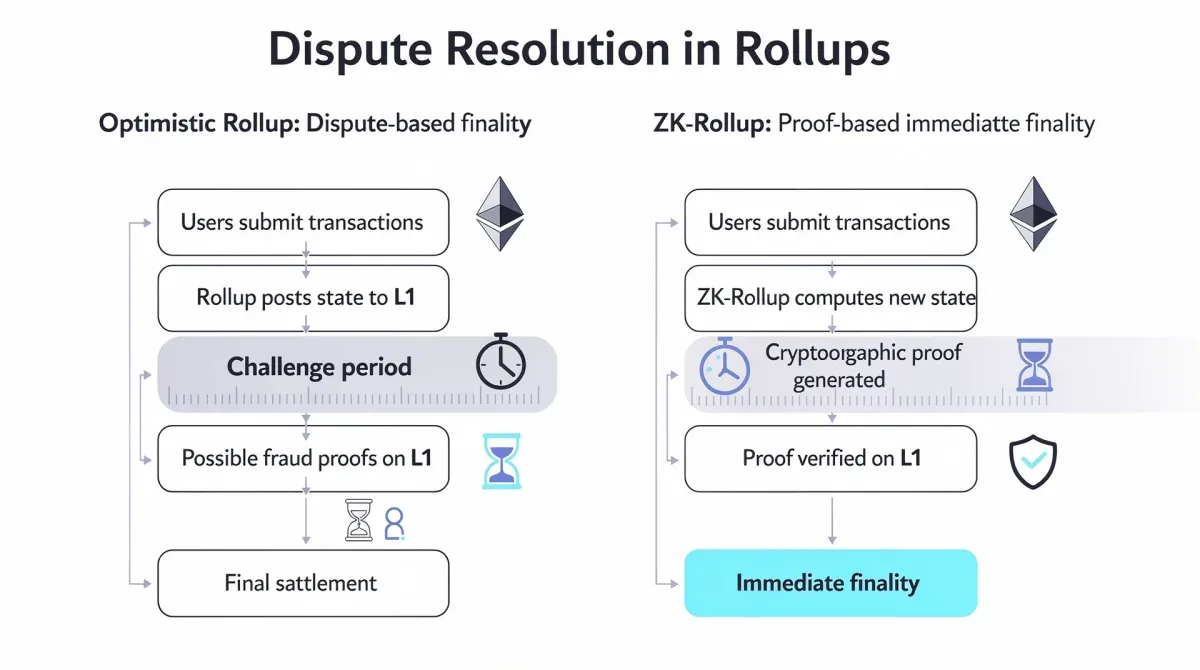
When a batch of transactions is processed off-chain by a ZK-Rollup, a cryptographic proof is generated that attests to the validity of every single transaction in that batch. This proof is then submitted to the Layer-1 blockchain. The Layer-1 smart contract can quickly and efficiently verify this proof, confirming the integrity of the entire batch without having to re-execute or inspect each individual transaction.
- Cryptographic validation: Proofs mathematically guarantee the correctness of off-chain state transitions.
- Immediate finality: Once the proof is verified on Layer-1, the transactions are considered final, with no dispute period needed.
- Enhanced privacy: While not fully private, the nature of zero-knowledge proofs means transaction details are not exposed on Layer-1.
The efficiency of verifying a single, compact proof, rather than thousands of individual transactions, is what drives the significant cost reductions and increased throughput. This method effectively bypasses the need for a challenge period, which is a characteristic feature of Optimistic Rollups.
The ability to provide instant finality is a major advantage for ZK-Rollups, particularly for applications requiring rapid settlement or high-frequency trading. Users can be confident that their transactions are secure and irreversible almost immediately after the proof is submitted and verified on the main chain. This certainty, combined with the inherent security of cryptographic proofs, positions ZK-Rollups as a highly robust and scalable solution for the future of decentralized finance and beyond.
Optimistic Rollups: Fraud proofs and dispute resolution
Optimistic Rollups offer another compelling Layer-2 scaling solution, distinct from ZK-Rollups in their approach to transaction validation. As their name suggests, Optimistic Rollups operate on the 'optimistic' assumption that all off-chain transactions are valid by default. This approach allows for faster and cheaper transaction processing, as cryptographic proofs are not generated for every batch. However, this optimism necessitates a robust dispute resolution mechanism to ensure the integrity of the network.
Instead of relying on complex cryptographic proofs for every batch, Optimistic Rollups introduce a 'challenge period' during which anyone can submit a 'fraud proof' if they detect an invalid transaction within a submitted batch. If a fraud is successfully proven, the invalid transaction is reverted, and the sequencer (the entity that bundled and submitted the batch) is penalized. This system incentivizes honest behavior and provides a strong deterrent against malicious activity.
The mechanics of the challenge period
When a batch of transactions is submitted from the Optimistic Rollup to the Layer-1 blockchain, there's a predefined time window, typically around 7 days, during which the transactions are considered 'pending.' During this challenge period, any participant can scrutinize the off-chain computations. If an error or fraudulent transaction is identified, a fraud proof is submitted to the Layer-1 contract. The contract then re-executes the disputed transaction (or a portion of it) on-chain to verify the claim.
- Default validity: Transactions are assumed valid unless proven otherwise.
- Challenge period: A time window for anyone to submit fraud proofs.
- Fraud proofs: Mechanisms to prove an invalid state transition, leading to penalties for dishonest actors.
This reliance on an interactive dispute resolution process is a key differentiator. While it introduces a delay in finality (users must wait for the challenge period to pass before their funds are truly settled on Layer-1), it simplifies the off-chain computation significantly, making Optimistic Rollups generally easier to implement and less computationally intensive than ZK-Rollups in terms of proof generation.
The security of Optimistic Rollups ultimately rests on the assumption that there will always be at least one honest validator monitoring the rollup and willing to submit a fraud proof if an invalid state transition occurs. This economic incentive model, combined with the ability for anyone to challenge, ensures the long-term integrity of the rollup's state. While the delayed finality is a consideration, for many applications, the significant cost savings and increased throughput offered by Optimistic Rollups outweigh this trade-off.
Key differences: ZK-Rollups vs. Optimistic Rollups
The choice between ZK-Rollups and Optimistic Rollups often comes down to a careful evaluation of their distinct trade-offs in terms of security, finality, and complexity. Both aim to scale blockchain networks and reduce costs, but they achieve these goals through fundamentally different mechanisms, each with its own set of advantages and disadvantages for specific use cases.
One of the most significant distinctions lies in their validation methods. ZK-Rollups use cryptographic proofs to ensure the validity of off-chain transactions before they are settled on Layer-1. This provides an ironclad guarantee of correctness and immediate finality. In contrast, Optimistic Rollups assume transactions are valid and rely on a fraud-proof system during a challenge period, leading to delayed finality but potentially simpler implementation.
Security and finality: A critical comparison
For ZK-Rollups, security is mathematically guaranteed by the zero-knowledge proofs. Once a proof is verified on Layer-1, the state transition is irreversible and considered final. There's no period during which a transaction can be challenged or reverted. This offers a high degree of confidence and is ideal for applications where immediate settlement is paramount.
- ZK-Rollups: Immediate finality, cryptographic security, no challenge period.
- Optimistic Rollups: Delayed finality (due to challenge period), security relies on economic incentives and active monitoring.
Optimistic Rollups, while secure under the assumption of honest monitoring, introduce a waiting period. This delay can impact user experience for certain applications, such as fast withdrawals or cross-chain transfers, where users might prefer instant confirmation. However, for many other use cases, the week-long challenge period is an acceptable trade-off for the increased throughput and lower gas fees.
Another factor is the computational complexity. Generating zero-knowledge proofs can be computationally intensive, requiring specialized hardware or significant processing power, which can add to the operational costs of a ZK-Rollup. Optimistic Rollups, by avoiding this proof generation, can sometimes be simpler to operate, though they require a robust monitoring infrastructure for fraud detection. The choice between these two powerful scaling solutions ultimately depends on the specific requirements of the decentralized application, balancing the need for instant finality with overall operational complexity and cost.
The promise of 88% cost reduction: Real-world impact
The potential for Layer-2 solutions, particularly ZK-Rollups and Optimistic Rollups, to slash smart contract execution costs by as much as 88% is not merely theoretical; it's being demonstrated in real-world applications. This dramatic reduction transforms the economic viability of decentralized applications, making them accessible to a much broader user base and enabling entirely new use cases that were previously hindered by prohibitive gas fees on Layer-1 networks like Ethereum.
Consider a scenario where a simple DeFi transaction, such as swapping tokens or providing liquidity, might cost tens or even hundreds of dollars during peak network congestion on Ethereum. With a rollup, the same transaction could cost just a few dollars, or even cents. This difference is profound, moving blockchain interactions from a niche luxury to an everyday utility for millions of users.
Impact on decentralized finance (DeFi)
DeFi protocols are among the biggest beneficiaries of Layer-2 scaling. High transaction costs have historically been a significant barrier to entry for smaller investors or those engaging in frequent, low-value transactions. By reducing these costs, rollups make DeFi more inclusive and liquid.
- Increased accessibility: Lower fees open up DeFi to a wider range of users, including those with smaller capital.
- New product development: Developers can build more complex and interactive dApps without worrying about overwhelming user gas costs.
- Improved user experience: Faster transactions and predictable costs lead to a smoother and more enjoyable experience.
The ability to execute smart contracts at a fraction of the cost means that micro-transactions, small-scale gaming interactions, and frequent updates for social dApps become economically feasible. This unlocks a vast potential for innovation, allowing developers to design applications that rely on many on-chain interactions without penalizing users for every single action.
Ultimately, the 88% cost reduction is a game-changer. It signifies a maturation of blockchain technology, moving it closer to mainstream adoption by addressing one of its most critical pain points. As these Layer-2 solutions continue to evolve and become more robust, we can expect to see an explosion of new applications and a significant expansion of the global decentralized economy.
Future trends and hybrid solutions
The landscape of Layer-2 scaling is dynamic and constantly evolving. While ZK-Rollups and Optimistic Rollups currently dominate the conversation, the future will likely see further innovation, including hybrid approaches and specialized solutions tailored to specific blockchain needs. The goal remains consistent: to enhance scalability, reduce costs, and improve user experience without compromising the foundational security of Layer-1 networks.
One emerging trend is the development of 'ZK-Optimistic' hybrids, which attempt to combine the best features of both rollup types. These could potentially offer faster withdrawals than pure Optimistic Rollups while being less computationally demanding than pure ZK-Rollups. The modular blockchain paradigm also plays a crucial role, allowing different layers to specialize in execution, data availability, and settlement, further optimizing efficiency.
The rise of app-specific rollups and modular blockchains
Beyond general-purpose rollups, we are seeing a trend towards app-specific rollups. These are custom-built Layer-2 solutions designed to optimize performance for a single application or a specific set of applications. By tailoring the rollup's architecture to the needs of a particular dApp, developers can achieve even greater efficiencies and lower costs.
- Specialized optimization: Rollups designed for specific applications can achieve peak performance for their use case.
- Modular design: Breaking down blockchain functions into specialized layers allows for greater flexibility and scalability.
- Interoperability: Future solutions will focus on seamless communication and asset transfer between different rollups and Layer-1s.
The modular blockchain approach, where execution, data availability, and consensus are handled by separate, optimized layers, is gaining traction. This design philosophy enables greater flexibility and allows each component to scale independently, leading to a more robust and scalable ecosystem overall. It also paves the way for a more interconnected web of Layer-2 networks, where assets and data can flow freely between different rollups and the main chain.
As these technologies mature, we can anticipate a future where users interact with dApps almost entirely on Layer-2 solutions, with the underlying Layer-1 acting primarily as a secure settlement layer. This evolution promises to unlock the full potential of blockchain, making it a truly global and accessible platform for innovation and economic activity.
| Key Feature | Description |
|---|---|
| ZK-Rollups | Utilize cryptographic proofs for immediate transaction finality and strong security guarantees. |
| Optimistic Rollups | Assume transactions are valid, relying on a challenge period and fraud proofs for security, leading to delayed finality. |
| Cost Reduction | Both reduce smart contract execution costs by bundling transactions off-chain, achieving up to 88% savings. |
| Scalability Impact | Significantly increase transaction throughput and decrease fees, making dApps more accessible. |
Frequently asked questions about Layer-2 rollups
What is a Layer-2 scaling solution?▼A Layer-2 scaling solution is a framework built on top of an existing blockchain (Layer-1) to improve its performance. It processes transactions off-chain, then bundles them and submits a summary back to the Layer-1, drastically reducing congestion and fees while inheriting the Layer-1's security.
How do ZK-Rollups achieve immediate finality?▼ZK-Rollups achieve immediate finality by generating cryptographic zero-knowledge proofs for off-chain transactions. These proofs mathematically verify the correctness of the transactions without revealing their details. Once this compact proof is validated on the Layer-1, the transactions are considered irreversible and final.
What is the challenge period in Optimistic Rollups?▼The challenge period in Optimistic Rollups is a timeframe, typically around 7 days, during which any network participant can dispute the validity of a batch of off-chain transactions submitted to the Layer-1. If fraud is detected and proven, the incorrect transactions are reverted, and the responsible party is penalized.
Why are Layer-2 solutions important for smart contract costs?▼Layer-2 solutions are crucial for smart contract costs because they bundle many individual transactions into a single batch. This means the high gas fee of the Layer-1 network is amortized across hundreds or thousands of transactions, dramatically reducing the per-transaction cost and making dApps more affordable.
Can ZK-Rollups and Optimistic Rollups work together?▼Yes, while they have distinct mechanisms, ZK-Rollups and Optimistic Rollups can coexist and even complement each other within the broader blockchain ecosystem. Future innovations may include hybrid solutions or specialized applications that leverage the strengths of each technology for different use cases, fostering a more scalable network.
Conclusion
The journey through the intricate world of ZK-Rollups vs. Optimistic Rollups: How Layer-2 Architecture Cuts Smart Contract Execution Costs by 88% reveals a pivotal moment in blockchain evolution. These Layer-2 scaling solutions are not merely technical enhancements; they are fundamental shifts that promise to unlock the true potential of decentralized applications and the broader web3 economy. By drastically reducing transaction costs and improving throughput, they address the critical scalability challenges that have historically limited mainstream adoption. Whether through the cryptographic certainty of ZK-Rollups or the fraud-proof mechanisms of Optimistic Rollups, the future of decentralized finance, gaming, and countless other applications will undoubtedly be built on these innovative foundations, making blockchain technology more accessible, efficient, and economically viable for everyone.
